


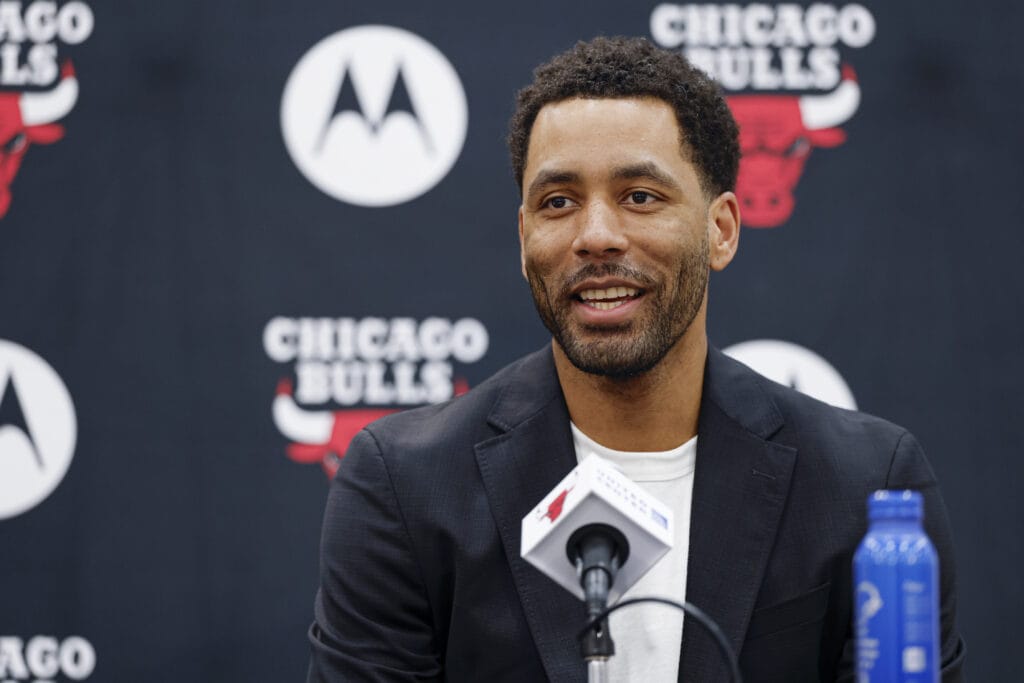
With the whole front office watching from their perch above the Advocate Center courts, a slightly worn version of Bryson Graham made his way to the podium.
Just two months on the job and Graham has already met with Bulls media on four occasions with a few radio appearances sprinkled in. Seemingly exhausted by the first round and pre-draft process, he still managed to muster some excitement. It’s not often you get to draft a potentially franchise-changing talent at the top of the draft, after all.
“Caleb Wilson, we took at four. Really, really, really, really excited about it,” Graham said after the first round on Tuesday night. “He just brings so much opportunity to the table. He’s such a good athlete, he’s a really high character, extremely skilled, and very versatile. Just excited about him being a part of this organization, helping building out this culture, and you know, real reestablishing our identity as a team.”
Though the top four of this draft were considered unmovable throughout the draft process, Graham tried to box out the noise. Going through each step, evaluating the film, executing the workouts and conducting the interviews, the Bulls ultimately landed on the consensus. But they did so by going through their own process.
Wilson projects as somewhat of a work-in-progress, but one of the most productive projects in recent draft memory. His athletic tools give him perhaps the highest ceiling in the draft. And though he has to undergo some refinements, it’s not hard to see a franchise player hiding in plain sight, even if the Bulls want to keep expectations in check.
[Caleb Wilson Scouting Report]
“You want guys with very high confidence,” Graham said. “He was obviously a top-five pick, so a lot of expectations come along with that. But I think you have to be careful with tempering some of those expectations, even that he has for his own self. I know he’s going to get there, but growth and development is not linear. Although he’s going to be a great player, we’re going to do everything we can to get him there. We know that his development is just going to obviously take time, but that mentality is what we want in this building”
He shared similar excitement about the 15th pick, Dailyn Swain, another big wing with dribble-pass-defend qualities.
“And Dailyn, can’t say enough about him,” Graham went on. “Although he went to the University of Texas — and then he had the nerve to throw a little shade at me when we were talking on the phone — but again, another high character kid. That’s so important that we bring those kind of guys in here. He’s tough, he’s versatile, can play multiple positions on both offense and defense. Just really, really excited about those two guys. They were targets for us in this process, and I think they fit well with Coach Tiago’s personality and his style of play.”
Graham certainly has a type. The S.LA.P. acronym has gotten a lot of use over the last few weeks, but the Bulls executive meant what he said. Both Swain and Wilson embody the principles — size, length, athleticism, physicality — to a T.
[Dailyn Swain Scouting Report]
Inheriting a roster with only nine players under contract, Graham has yet to put his mark on the team’s identity. Though he’s added Wilson and Swain, along with Nicolas Claxton and Kam Jones, acquired via trade, the clunky fit of reluctant shooters and similarly shaped bodies has yet to be resolved. The initial reaction to the Claxton deal signaled a conservative, low-upside move meant to avoid the relegation zone rather than to ultimately compete for a championship. The process behind these two draft picks, along with Graham’s assurances, began to quell that agitation.
“We’re getting there, and definitely not where we want to be, but we’re establishing an identity,” Graham said. “I think that’s really important for this organization, especially right now. Both Caleb and Dailyn, they fit the bill. We’re not addressing every skill yet. A lot of people might (say), ‘where’s the shooting at’, and things of that nature. I’m not typically worried about that right now. There’s this certain mentality and a certain profile in a way that Coach Tiago and myself want to play, and we felt like today was a good layer for that.”
If the mindset is to evaluate the draft picks based on how they fit with Josh Giddey, Matas Buzelis, Leonard Miller, and Noa Essengue, Wilson and Swain don’t make as much sense. They’re limited shooters, both will need the ball, and neither are ready-made to accentuate the strengths of the remnants of the Arturas Karnisovas era.
But Graham’s job is not to enhance the roster Karnisovas left him, rather to build out the version that personifies his basketball values. That doesn’t mean everyone must go, but that the lack of cohesive fit is not and should not be an issue. At least not right now.
“Shooting, it obviously is a skill that can improve,” Graham said. “Both guys, I think mechanics are sound, both shots are compact. I see guys that can develop that. Some history behind some of the guys that were taken in my previous draft history were guys that improved their shooting over the years. So when you check a ton of other boxes, defending, play-making advantage, creating, and maybe shooting is somewhat of a weakness at the moment, it doesn’t deter me from taking you. The mentality, the work rate, and variety of skills is really, really important.”
The challenge at hand is to get the most talent in the door. That’s why they hired an executive whose reputation was built on his success in the draft. It’s also what made the second night of the draft a familiar disappointment.
After a busy first night, the Bulls got their work done early for the second round. An abrupt conclusion to an extended honeymoon.
An hour before the second round, the Bulls sold their 56th overall pick to the Lakers for old friend cash considerations. Not a great look as the team tries to rebuild through the draft, but not enough to spoil the high of nabbing Wilson and Swain. And they still had No. 38.
But when that 38th pick rolled around, their selection, Purdue’s Braden Smith, was traded to the Indiana Pacers for Kam Jones, second-round pick swaps in 2028 and 2030, and — that’s right — cash considerations.
There were some interesting players on the board for the Bulls then (Henri Veesaar, Emanuel Sharp, Jack Kayil, Felix Okpara, Ja’Kobe Gillespie, to name a few). At face value, moving an early second-rounder isn’t going to set the franchise back. It’s more valuable than a late one, but that’s really not the point either.
The cash considerations bit is a comical footnote in recent Bulls’ lore, but it’s more about the principle than the cash itself. The Bulls hired Graham because of his scouting pedigree, not only in the first round, but for his ability to find hidden gems in the second round and on the undrafted market. And supposedly, the Bulls were finally sparing no expense. Rather than allowing him to flex that superpower or put those picks towards meaningfully improving the roster, they simply cashed out.
Second-round picks are currency. The Bulls valued them enough, at one point, to accept them for Coby White, Ayo Dosunmu and Nikola Vucevic. The Rockets were able to use them, trading Nos. 39 and 53 to move up to No. 31. That’s a deal the Bulls easily could have beaten if there was a target Graham liked.
The Grizzlies traded three seconds to acquire Isaiah Stewart from the Pistons in a salary dump. Making just $15M (with another $15M team option on year two), he’s a superior player on a more team-friendly contract than Claxton. Not only would that deal have been a preferable use of the Bulls’ cap space, but it would also have been a far better use of the second-round picks, putting them towards acquiring the better player rather than eventually selling them for cash.
Maybe there really wasn’t anyone left on the draft guru’s board. Maybe Claxton is better than Stewart. Maybe Jones turns into a player. Maybe the swaps turn out to be valuable in the new lottery reform system, where the top of the second round is in reverse order of the flattened first-round lottery. So much can still happen to add context to any single move. Graham deserves credit for clearly articulating the thought process. But no matter the spin, there’s never a good basketball reason to sell a draft pick.
That cash can’t be used to help the cap sheet. They didn’t create any additional roster spots for added maneuverability on the free agent market — the 38th pick would have replaced Jones’ roster spot and the 56th pick would have been a two-way. They acquired second round swaps, not picks, so there’s no additional future picks to show for pushing the assets forward. And the aforementioned trades around the league prove those picks could have been put towards any of those variables.
The draft is over, and the Bulls came away with two exciting young players they can start building around. Hitting on those picks will matter way more than whatever happens with these seconds. Free agency kicks off Tuesday evening with unimaginable chaos to come. There’s so much to be excited about when it comes to the Graham era.
So much feels new and fresh. Yet this process feels like more of the same.

1 Comment
bear with me
Great piece and it really articulated some very loose thoughts/feelings I’ve had around the new management and this draft. I would have to chalk it up to a lot of pieces which needed to fall into place in a short amount of time between the new GM and HC. Some details slipped through the cracks and, to your point, let’s hope that they nailed the details at the top of the draft and that they start getting the smaller details right very soon.
I give Graham a lot of credit for being available and providing some explanation of his thought process. Poles mostly tries re: the Bears and the master of this was Theo. As long as he’s trying I think he’s really helping himself.