


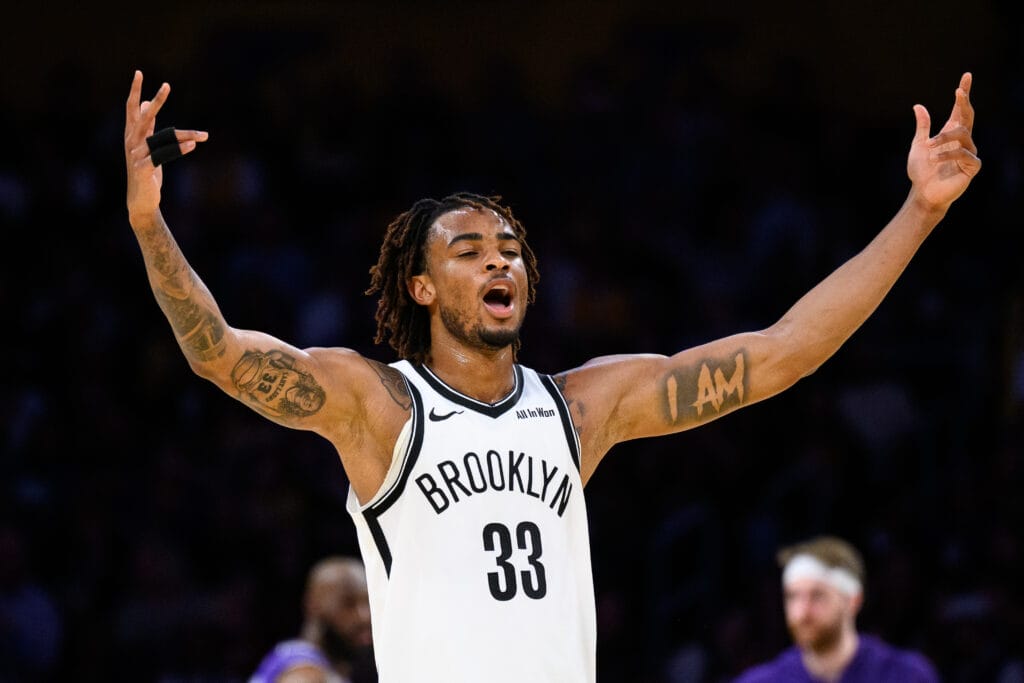
The first trade of the Bryson Graham era has occurred.
The Bulls have acquired Nic Claxton, 27, from the Brooklyn Nets in a three-team deal. The Minnesota Timberwolves sent Julius Randle and the No. 28 pick to Brooklyn. The Nets sent pick No. 33 back to Minnesota and Claxton to the Bulls.
The Bulls sent Mouhamadou Gueye’s non-guaranteed contract back to Minnesota to make the deal legal. Because the Bulls are using cap space to absorb Claxton’s money, this deal won’t be finalized after the turn of the league year.
Claxton has two years left on his deal, taking him through his age 28 season. Making $23.3M this season and $21.1M in 2027-28, the Bulls were able to absorb him into their league-leading amount of cap space in order to facilitate the deal with the Nets and Wolves. This is essentially a two-year free agent signing, and Claxton is the 13th highest paid center in the league, but will likely slide a few spots after free agency wraps up.
This deal reduces the Bulls cap space from about $54 million to about $31 million, still giving them enough flexibility to continue taking on contracts, facilitating future deals, and absorbing contracts.
Graham has now put the first imprint on the Bulls roster, adding a defensive anchor, and rim rolling lob threat. There will be opportunity costs associated with adding $23.3M to their payroll, but it’s a price Graham and company should be happy to pay for a serviceable starting center.
Claxton has spent his seven-year career in Brooklyn. He averaged 11.7 points on 57.1 percent shooting, with 6.9 rebounds and 1.1 blocks in 68 games last season. Over the last few seasons, the Nets have been actively trying to lose games, which has reduced his minutes, workload and viability from his peak during the 2022-23 season. That year, he was ninth in Defensive Player of the Year voting, averaged 12.6 points and 9.2 rebounds with 2.5 blocks per game.
Claxton is also a nice passer and playmaker out of the short roll. He averaged 3.7 assists per game last season, and had a 21.6 assist percentage, which ranked in the 96th percentile among centers.
With that being said, Claxton has also dealt with back injuries that have impacted his availability and productivity. Last season, Claxton had a -2.1 DPM, ranking 465 out of 582 players in the NBA. As a result, his contract is considered underwater by about $18M this year and $46M total. EPM had a more favorable, but still disappointing evaluation of +0.4, 74th percentile.
He’s not the same athlete or defender he used to be, and with centers of his ilk, injury and age-related decline often early. Perhaps that is part of the reason the Nets were willing to move off their homegrown product.
This acquisition also raises questions about the Bulls timeline. Claxton is already into his prime years, and may have already played his best basketball. The Bulls are about to draft their first core piece, a 19-year-old, on draft night. Claxton doesn’t have to be a perfect timeline match, but it does raise some questions about how this works towards building a sustainable, long-term, contending roster.
The incentive for the Wolves is to clear out space to be able to re-sign Ayo Dosunmu, which they did shortly after the Randle dump. By lopping $33M off their books, they freed up the space to give Dosunmu $112M over five years, while also opening a large trade exception that can be used later.
As for the Nets, they get to move up five spots, from 33 to 28, into the first round, while also taking in about $12M in salary more than they are sending out. For them to agree to this deal, they must value Randle significantly more than they value Claxton.
Notably, the two teams with the most cap space this summer, the Bulls and the Nets, took on significant money in the same deal, reducing the amount they can use in other deals. While this takes the Bulls out of the running for a max offer sheet on Jalen Duren or Walker Kessler (probably for the best), they still have the ability to use their remaining cap space to take on bad salaries for draft picks. That should be their primary focus moving forward to improve their longer term odds, not just boosting their floor in the present.
With the new lottery rules reducing odds for the three worst teams in the league, this move is a fine first step for the Bulls. If you view Claxton as a positive asset, getting such a player without giving up any assets is a good piece of business.
If your view of Claxton is more in line with the most recent projections, the Bulls should have gotten an asset to take on his deal.
That’s just the immediate evaluation — the impact on the present. More importantly, this tells us very little about Graham’s vision to build the team up to contention, because Claxton doesn’t raise the Bulls championship equity today or tomorrow.
That’s fine. Barring a superstar trade, no single move would vault the Bulls into the inner circle of title contenders. But that’s not the point. The point is, this move doesn’t align with a long-term strategy to put the Bulls on a path that eventually leads them there. And that should be considered a yellow flag for Graham’s first action at the head of the table.

2 Comments (1 conversation)
scott pollak
This seems a lot like an akme trade — except for the rim protection.
If the bulls are going to take on an injured big man to facilitate other teams trades why aren’t they getting draft assets. SMH.
bear with me
They get decent defense, with some potential upside, on an expiring contract. I think this raises their floor in the short term and they can easily part ways in two years if it’s not working. AKME sat on their thumbs for a year, then paired Vooch, Lonzo, DeMar and LaVine by paying lots of money and draft capital on a dice roll.
I agree that they should be getting draft assets, but they still can absorb salary and already have a very young team to develop. You need some veteran presence somewhere and it may as well be in the middle.