
The MLB offseason is off and running, with option decisions and some signings already taking place.
This winter will be different for the Cubs in several ways. Last year, the core of the group was pretty much set — the lineup had very few openings apart from Kyle Tucker’s departure and the starting rotation was mostly solidified.
This year, half of the roster could be different on Opening Day 2027 (whenever that is). And on that second part … a lockout is expected to begin on the night of Dec. 1.
We have some idea of how that affects an offseason after we saw it in 2021-22. Some players will be in a rush to sign and teams feel an extra emphasis on making moves before that Dec. 1 date. We saw as the lockout ended in March 2022, it was an all-out sprint to get spring training off the ground and the league ready for a 162-game season.
So these next few weeks will be very interesting — and could be very telling on what Jed Hoyer and Co. have planned to get the Cubs back on track.
“We’re going to have to have a good offseason,” Hoyer said at his end-of-season press conference. “Going to be creative. We’re going to have to fill a number of holes.”
They will, indeed.
Let’s take a look at where the Cubs currently stand before the offseason really starts to heat up with a 26-man roster projection.
Important note: This is where the roster stands right now. It is not forecasting or predicting offseason moves. It’s an idea of what the roster would look like if the season started tomorrow — and underscoring the areas of need for Jed Hoyer’s front office.
CATCHERS
Miguel Amaya
Owen Ayers
Carson Kelly is a free agent, though I wouldn’t be surprised at all if he comes back. He and the Cubs were clearly a good fit — defensively and from a game-calling standpoint plus he was a solid contributor to the lineup over the last two seasons.
Amaya finally stayed healthy for a full season in 2026 and put together a solid — if unspectacular — campaign. He had 1.4 bWAR and was essentially a league-average hitter (98 OPS+), though he only drove in 28 runs with 6 homers and a .377 slugging percentage. For context, he hit 4 homers with 25 RBI in 151 fewer plate appearances in 2025.
Amaya will still only be 28 years old in March, but it doesn’t look as if he will ever develop into an everyday catcher in Chicago.
Ayers, on the other hand, exploded in the Cubs system in 2026. A switch-hitting former 19th-round pick in 2024, Ayers played at three levels, topping out at Triple-A. He hit 25 homers with a .289/.403/.526 slash line (.929 OPS) and still held his own at Iowa.
Ayers is older for a prospect — he’s actually only two years younger than Amaya (turning 26 in June) — but he looks like the catcher of the future and that could start as soon as Opening Day depending on what the Cubs do with the rest of the offseason.
INFIELDERS
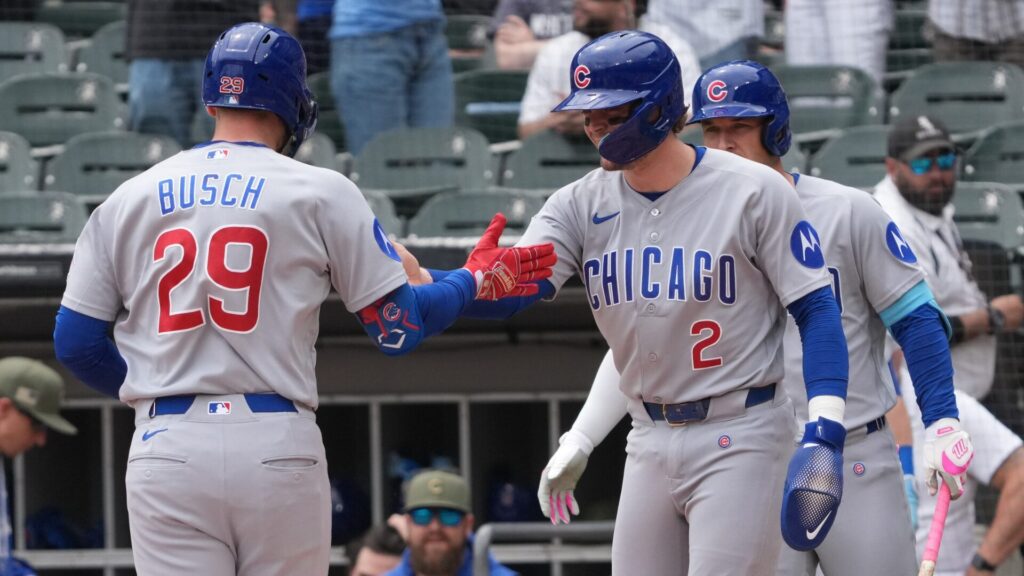
Michael Busch
Nico Hoerner
Dansby Swanson
Alex Bregman
Pedro Ramírez
BJ Murray Jr.
James Triantos
The first part of this roster projection is as simple as it comes with zero surprises. The Cubs have a locked in core of infielders — one at each position. And it’s a strong group, with the potential for more as both Hoerner and Busch are coming off down seasons after excelling in 2025 and Swanson missed a month due to injury.
Ramírez was a major success story for the organization in 2026 and will slot in in some fashion on the roster next year. He could factor into the DH spot or give other guys half-days off (like playing third base while Bregman DHs). He could also potentially play the outfield, though he has very little experience there in the pros (1 inning in left field in the majors and 44 innings at the spot in the minors).
After that, the next couple spots are up for grabs. The Cubs went most of the year without a true backup first baseman, so it’s possible they target a right-handed hitter to complement Busch. However, Busch performed well against lefties in his first season playing every day.
Murray and Triantos each made their MLB debuts in 2026, but combined for just 20 plate appearances. Both have some versatility and can play the outfield, so they may factor into the equation as bench/utility players.
OUTFIELDERS
Pete Crow-Armstrong
Matt Shaw
Kevin Alcántara
Justin Dean
This is the main area of need for the Cubs on the position player front, as both corner outfielders (Seiya Suzuki, Ian Happ) are hitting the free agent market. The Cubs only extended a qualifying offer to Suzuki, who is expected to fetch a pretty big contract as one of the best bats available this winter.
It’s possible the Cubs bring one of those players back but if they don’t, it will be tough to replace the production from both spots. Shaw could ascend into an everyday role after getting his first taste of the outfield in 2026, though he battled injury and took a bit of a step back after a promising rookie campaign.
Alcántara has yet to live up to his tantalizing potential, appearing in just 37 big-league games over the last three seasons and compiling -0.3 WAR and a .584 OPS. He is out of minor-league options, so he will need to be carried on the 26-man roster on Opening Day or the Cubs would risk losing him to another organization.
Alcántara is only 24 and is a right-handed bat, so the most likely bet right now is he carves out a role as a platoon player on the Opening Day roster.
Dean is a role player who defends and runs well, but he has options remaining so his most likely place (if he stays with the Cubs) is as a depth piece in the minors.
ROTATION
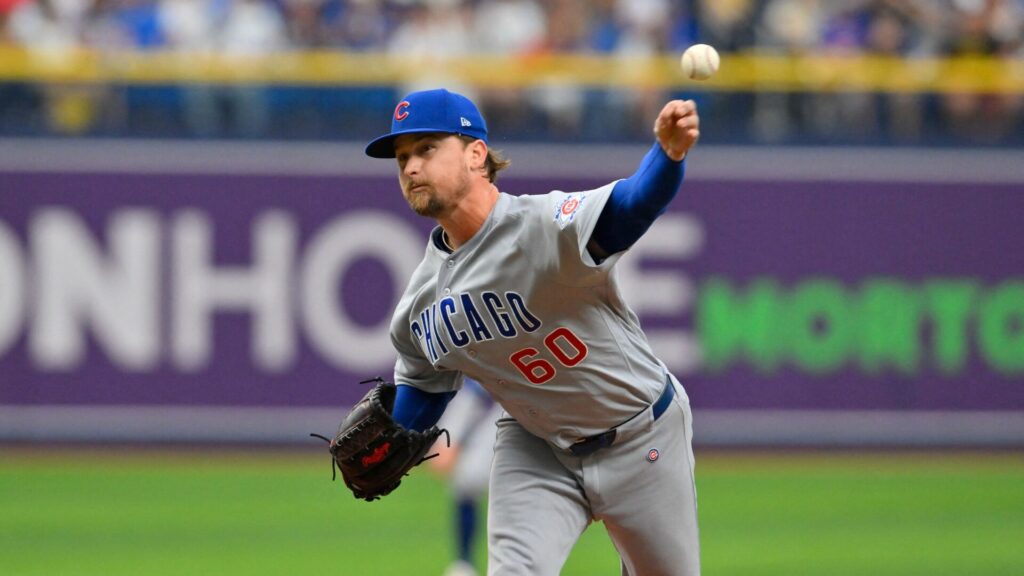
Justin Steele
Edward Cabrera
Javier Assad
Braxton Garrett
Ben Brown
This group is jam-packed with question marks and will be the top area to address for the Cubs front office this winter.
When Steele takes the mound for the first time in 2027 (whenever that is), it will have been two full years since he last pitched in a big-league game. Will he return to the form that saw him contend for an NL Cy Young? And even if he does, how many innings can the Cubs count on him for coming off essentially two missed seasons?
Cabrera has his own question marks, as he posted an ERA near 6.00 in his first season in Chicago while landing on the IL three separate times. He was banished to the bullpen late in the year as he dealt with troublesome blister issues. He still has immense potential and elite-level stuff on the mound. But can he put it all together?
Assad has been an unsung hero on the pitching staff for years and will almost assuredly fill the same role in 2027 as a swingman who bounces back and forth between the rotation and bullpen as well as the majors and Triple-A.
Garrett is out of options, so will need to be kept on the Opening Day roster in some form. The Cubs quietly traded for him at the deadline as he recovered from a second Tommy John surgery in December 2024.
The 29-year-old lefty has had MLB success before, posting 5.6 WAR and a 3.63 ERA in 247.2 innings between the 2022-23 seasons. He pitched well in the minors for the Marlins as he made his way back to the big leagues (2.90 ERA in 77.2 innings).
Brown may be the biggest question mark of them all, as a mysterious neck injury shut him down for the second time in the last three seasons.
Did Brown and the Cubs medical staff finally get to the bottom of the issue? Will he be able to put it in the rearview mirror for good? Will he be ready by Opening Day? Will he be able to handle a starter’s workload? And even if all of those are answered, how will he perform? Brown has been up-and-down throughout his big-league career, though he had turned a corner and enjoyed a breakout campaign in 2026 before landing on the IL.
The Cubs had unbelievably bad injury luck with their starting rotation in 2026, but it also should have taught them a lesson (albeit a lesson they didn’t truly need to learn again): You can never have too much pitching.
There is no wave of starting pitching coming up through the minors and knocking at the door in Chicago. The Cubs will need to address this position heavily in the offseason either via free agency or trade.
It would not be a surprise to see one (or maybe even multiple) of Clay Holmes, Matthew Boyd, Shota Imanaga or David Peterson back. But the Cubs also need to go out and shoot higher for impact arms — particularly pitchers with higher velocity who can miss bats.
Obviously Tarik Skubal fits into that mold perfectly, but the Cubs won’t be the only team bidding for the perennial Cy Young candidate. Other strong options exist beyond Skubal, like Michael King (who shut the Cubs down in the Wild Card round) or former Brewers ace Freddy Peralta.
BULLPEN
Daniel Palencia
Ryan Zeferjahn
Jacob Webb
Ryan Rolison
Shelby Miller
Phil Maton
Eric Orze
Gavin Hollowell
Orze, Hollowell, Tyler Ferguson and Ethan Roberts are all out of minor-league options, so it’s fair to expect one or multiple of those arms to be DFA’d or move teams before Opening Day next year.
The Cubs need optionable arms at the back of the bullpen — but they also need to build a quality relief group. That was one of the team’s main weaknesses in 2026, which Hoyer acknowledged fully after the season.
Maton was the biggest addition last offseason and signed a multi-year deal. His first season in Chicago was an abject disaster with a 6.18 ERA in 31 games and three trips to the IL for a knee issue that required surgery in September.
The veteran right-hander was one of the best relievers in all of baseball in 2025 and could regain his form with better health. Miller has also had success in big-league bullpens and looked sharp at times in the minors late in the year as he recovered from Tommy John surgery.
Webb was the team’s relief ace for much of the season, going two full months without allowing a run. But he fell on hard times and by the end of the season, was out of the circle of trust. Still, the Cubs worked to re-sign him and he will fill a spot in the bullpen in 2027 — potentially a high-leverage role.
Palencia also struggled with injuries in 2026, but he could be an elite closer if healthy next season. Zeferjah has eye-popping stuff and could potentially develop into a top setup man.
Rolison was a surprise success story in the bullpen in 2026 and should be a left-handed option in the ’27 crew.
The Cubs just claimed Orze off waivers, bringing the Elk Grove, Ill., native home. He found success in the Rays bullpen in 2025 (3.02 ERA) but struggled with the Twins in 2026 (5.66).
The Cubs actually have quite a few spots already filled in next year’s bullpen, but there is also clear room for improvement and the front office will need to address this group in the offseason.