
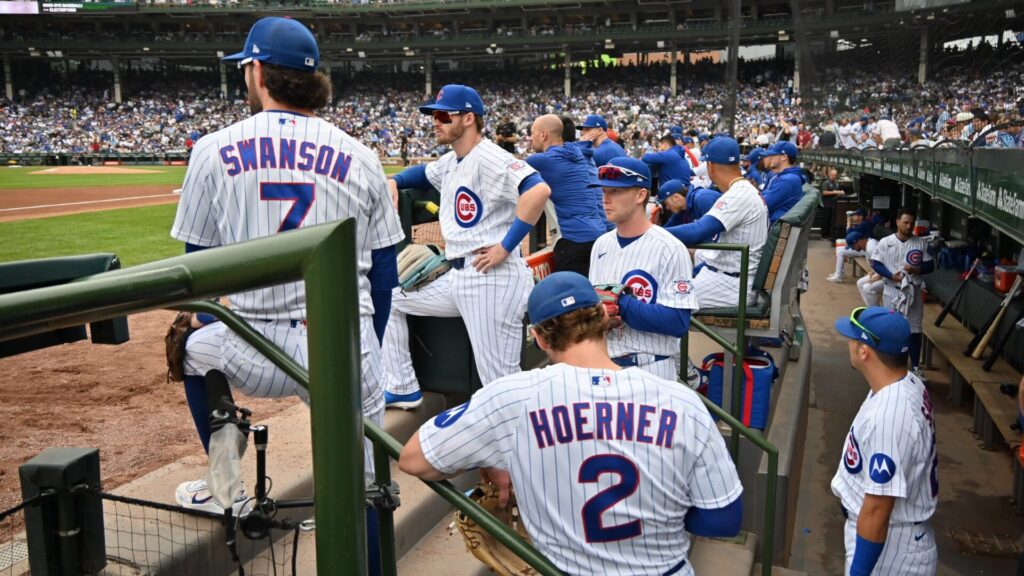
It’s fair to say the Cubs took a bit of a step back in 2026 compared to the season prior.
They won fewer games (92 to 89) and finished farther behind the Milwaukee Brewers (5 games back in 2025 vs. 14 back in 2026) in the NL Central.
The postseason also wasn’t as successful — clearly — as the Cubs came up one win shy of the NLCS last October and this fall, were eliminated before October even began in California (where they were swept in the NL Wild Card Series).
We know that all already. But how did the Cubs get to that point?
Here are the 7 most important developments in the 2026 season — some good, some bad — ranked in order of impact.
7. Pedro Ramírez’s breakout (and a couple of key minor league breakouts)
There are multiple components to this one.
First, the Pedro Ramírez part. The 22-year-old switch-hitting infielder went from afterthought in the Cubs farm system last year to key role player in the big leagues by June.
He showed well in the field (especially at third base) and at the plate as essentially a league-average bat (99 OPS+) during his first 80 MLB games. On top of that, he played four different positions (plus DH) and looks to be an important part of the team’s future.
On the other hand, Ramírez stands alone as really the only young player who really took a step forward to contribute at the big-league level.
Moisés Ballesteros was a key part of the lineup in the early going before being sent down to the minors and eventually traded at the deadline. Kevin Alcantara never made an impact in the big leagues and while B.J. Murray earning a spot in the majors in September was a feel-good story, he appeared in just 7 games and had 11 plate appearances.
The Cubs didn’t come into 2026 with a whole lot of room in the lineup, as they had a very veteran-laded group. But still, each successful season typically has a few surprise contributors or young players taking a step forward. And for the Cubs to get that type of contribution from only Ramírez is part of why the season ended the way it did.
In the minors, however, the Cubs had a couple of notable breakouts in catcher Owen Ayers and outfielder Josiah Hartshorn. They’re now the organization’s top two prospects, as both players exploded onto the scene in the minors.
Ayers could factor into the catching equation next season and Hartshorn looks like he might be roaming a corner outfield spot at Wrigley Field in the next couple of years.
6. A step back for key pieces
As we detailed earlier, each successful MLB season is rife with surprise contributors — players exceeding preseason expectations. The Cubs didn’t have much of that this year, apart from Pete Crow-Armstrong (more on that later) and Ramírez and maybe a few arms on the pitching staff.
In fact, they had several key pieces take at least a minor step backwards.
Nico Hoerner, Michael Busch and Matt Shaw all contributed significantly less in 2026 than they had in 2025. By Baseball Reference’s metric, all three saw a dip of more than 2 WAR from 2025 to 2026:
Nico Hoerner
2025 WAR: 6.2
2026 WAR: 2.1
Michael Busch
2025 WAR: 4.5
2026 WAR: 1.6
Matt Shaw
2025 WAR: 3.0
2026 WAR: 0.7
With Shaw, part of that was due to injury and a lack of starting role for much of the year (he appeared in just 77 games with 202 plate appearances).
But Busch and Hoerner both actually played more in 2026 and saw a noticeable dip in production. They were still valuable players, to be sure, but not at the borderline elite level they were at a year ago.
Busch saw a big dip in power, with 14 fewer homers and a slugging percentage 130 points lower in 2026. Hoerner’s batting average dropped 34 points, his OPS dipped 72 points and defensive metrics also decreased across the board.
In some ways, it’s actually rather remarkable that the Cubs had the best offense in baseball despite lesser production from these three key players. But that speaks to how valuable Crow-Armstrong was and the improved play of Alex Bregman in the second half.
Speaking of Bregman…
5. Bregman’s and Cabrera’s debut seasons
A year after the Cubs came so close to signing Bregman, Jed Hoyer’s front office inked the veteran third baseman to a five-year, $175 million deal this offseason.
It was a tale of two seasons for Bregman. He posted just a .359 slugging percentage and .696 OPS in the first half with 9 homers and 41 RBI as the contract looked like a potential bust.
After the All-Star Break, Bregman went on a heater with a .303/.384/.626 slash line (1.010 OPS) with 19 homers and 52 RBI.
And now, the contract unquestionably looks “worth it.”
Bregman also made a major impact behind the scenes, serving as a mentor to Crow-Armstrong and fitting in perfectly with the Cubs culture due to his competitiveness and relentless nature.
Cabrera, on the other hand, had a miserable season in so many ways.
The Cubs dealt for the 28-year-old right-hander in the offseason, sending top prospect Owen Caissie to the Marlins and taking a gamble on Cabrera’s elite stuff and enticing potential.
It — decidedly — did not work out.
Cabrera was on the IL three separate times and limited to only 18 games (15 starts). He struggled mightily in those outings with a 5.96 ERA and -1.4 bWAR.
If it wasn’t a blister issue (which put him on the shelf twice), it was a hamstring injury that led to him being carted off the field. On the mound, if it wasn’t control concerns, it was the longball.
The Cubs had the clear-cut best defense in baseball — a unit that made nearly ever pitcher on the roster better.
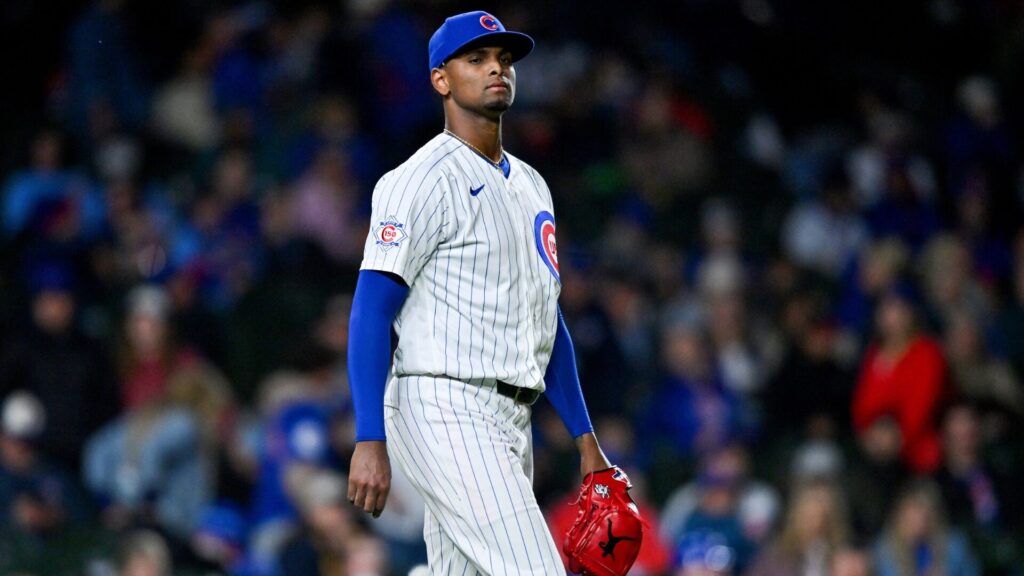
Except for Cabrera.
“We struggled with Edward,” Hoyer said at his end-of-season press conference. “Edward has had a lot of success in the big leagues. He’s a really good big-league pitcher. We have to think a lot about what things contributed to him struggling. And we have to look at ourselves and look at, what did we not do to get the most out of him?
“He did struggle a lot with these blister issues and how much that impacted his different spin pitches is unclear. But he’s super talented. He has the swing-and-miss stuff that we’re looking for. We didn’t get the most out of him and that’s something as an organization that we have to own — that I have to own. We need to really focus on that. He has a lot of talent, he really cares and we have to get more out of him.”
Cabrera has two more years under team control and it’s still possible he can turn back into the pitcher who posted a 3.95 ERA and 450 strikeouts in 405.1 innings between 2022-25.
But the shine has worn off the deal and the Cubs have no idea what to expect from Cabrera next year and beyond.
4. Bullpen blowout
Hoyer and Co. have found success building a bullpen in recent years by buying low on players and adding arms from the scrap heap.
This year, that was not the case.
This front office handed out a multi-year deal to a reliever (Phil Maton) for the first time since Craig Kimbrel in 2019, but that did not work out well at all. Maton had a 6.18 ERA in 31 games while dealing with a knee injury all year that required surgery late in the summer.
The other offseason moves — including Hunter Harvey, Hoby Milner and Jacob Webb — had varying degrees of success. Harvey didn’t pitch after early April and Milner only appeared in 38 games due to appendicitis that ultimately led to the Cubs DFA’ing him during his comeback.
Webb was the single most vital part of the bullpen for the first four or so months of the season before falling off in a major way.
Even the homegrown arm — Daniel Palencia — struggled as he was limited to only 29.2 innings due to injuries after pitching in the World Baseball Classic.
The only addition at the deadline — Ryan Zeferjahn — had mixed results, though he has nasty stuff and is under team control for several more seasons.
Ryan Rolison, Trent Thornton and Aaron Civale were good success stories, but it was nothing like the Brad Keller-Andrew Kittredge-Drew Pomeranz bullpen from a season ago.
Hoyer took ownership of the bullpen struggles in 2026:
A better bullpen wouldn’t have helped the Cubs in the Wild Card series in San Diego. But it would have helped the Cubs win more games in the regular season and have the chance to host the first playoff series at Wrigley Field — which could have meant all the difference.
3. Lack of pitching development in the farm system
Entering the playoffs a year ago, the bullpen was a clear strength of the Cubs and they rode that unit to a game shy of the NLCS.
This fall, the Cubs limped into the playoffs with a pitching staff lacking an ace or clear trusted relievers. The rotation essentially had a bunch of No. 3s while the bullpen did not have a clear closer or even reliable setup men.
Injuries played a major role in that and led to the Cubs being forced to give up a lot of capital to acquire Zeferjahn, Clay Holmes and Kevin Gausman at the deadline.
But you know what else played a factor? The Cubs’ clear inability to develop pitching in their system.
Hoyer and his predecessor, Theo Epstein, have often talked about needing waves of pitching to come up through the farm system. That has never materialized in the decade-and-a-half that Hoyer has been in town.
It was never more apparent than in 2026.
Ben Brown was a great success story early in the year, as he finally put it all together to realize his potential. But then his mysterious neck injury cropped back up and he wound up missing the entire second half of the season.
Other than that and Javier Assad’s continued steady production, the Cubs received essentially zero impact from homegrown pitchers (either drafted/signed by the team or acquired via trade as a prospect, like Brown).
The Cubs didn’t have any internal answers for the incredible slew of injuries that befell their pitching staff in 2026.
What’s more: Things don’t even look better for the future. Jaxon Wiggins is the organization’s top pitching prospect, but he had an up-and-down 2026 campaign and there is no guarantee he makes an impact in the big league.
It was far from a banner year for pitchers in the Cubs’ system. Wiggins is the only player knocking at the door.
And with roughly half the pitchers on the roster set to become free agents in the coming days, the Cubs will have an awful lot of holes to fill.
2. Injuries to ace-level arms
A big part of the reason for the Cubs’ need to acquire pitching this offseason is the unfortunate injury luck striking arguably the top three arms already on the roster.
Imagine if any one of Cade Horton, Justin Steele or Brown were healthy down the stretch for the Cubs. It is not crazy to think they would have been hosting the Wild Card Series at Wrigley Field if so.
And as if that isn’t bad enough, the picture isn’t exactly rosy moving forward.
The Cubs simply can’t enter 2027 believing they can rely heavily on Horton, Steele or Brown. There are no guarantees for any of the three pitchers — all of whom can be front-of-the-rotation starters.
Steele suffered a setback to his elbow injury and didn’t end up throwing a big-league pitch in 2026. As of right now, he’ll enter 2027 healthy, but what will his innings cap be? 100? 125 innings? Certainly the Cubs can’t count on a full season of Steele in the rotation.
Horton had to undergo Tommy John surgery in April and isn’t expected back until mid-summer of 2027. And that’s a best case scenario.
Brown has had two of his last three seasons wiped out due to this neck injury and also experienced a setback with it in August as he was attempting a comeback. The Cubs remain hopeful, but there are serious questions about Brown’s career at the moment.
We don’t know if Brown will be ready for Opening Day next year (whenever it is, lockout pending). And we don’t know if he will be able to get past the neck injury enough to pitch a full season. And even if he does, the 27-year-old is coming off a year in which he threw only 68 innings. How much can the Cubs expect from him in 2027?
1. Pete Crow-Armstrong’s ascension to superstardom — and an MVP
There was no single greater development with the Cubs in 2026 than Crow-Armstrong’s progression into the best player in baseball.
He put up himself firmly on the map as a “star” in 2025 with an epic first half. But the second half fade led to genuine question marks about Crow-Armstrong’s overall value and potential entering 2026.
He effectively silenced those doubts with one of the best seasons we’ve ever seen in baseball history.
Crow-Armstrong led the league in WAR, games played, plate appearances, runs scored, home runs, slugging percentage, OPS, OPS+ and total bases. All while stealing 41 bags and playing the best defense of anybody in the game.
His biggest weakness was a lack of plate discipline, as he walked just 4.5% of the time in 2025.
No problem. He upped that percentage by nearly 7 points in 2026 (11.4 BB%), completely changing his offensive profile without losing any power and only seeing a tiny increase in strikeout rate.
It was an incredible season and it also serves as a reminder of maybe the best decision Hoyer has ever made when he and the Cubs inked Crow-Armstrong to a $115 million extension prior to the season.
That contract looks like an absolute bargain right now and it is the single biggest reason why I am so bullish on the Cubs’ future.