

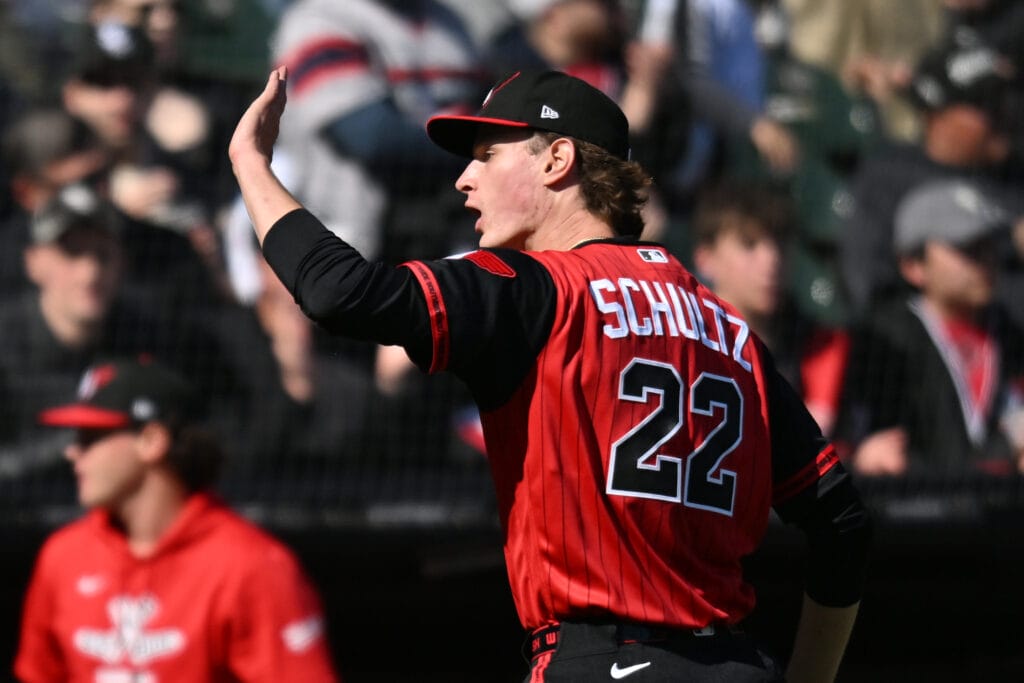
Decades ago, sportswriter John Feinstein famously described golf as a good walk spoiled. In a similar spirit, Noah Schultz’s Saturday afternoon start against the Nationals could be best characterized as a good start spoiled.
Schultz tossed his first ever quality start, going six frames and striking out eight, but the White Sox got just two runners into scoring position while he was on the mound. The offense put together a two-run rally in the eighth inning to tie the game and spare Schultz the insult of being assigned the loss after pitching that well, but the Sox ultimately lost, 6-3, in ten innings.
The good news is that Schultz continues to look like the real deal. Through three starts, Schultz now has a 3.52 ERA, 1.11 WHIP, and 18 strikeouts in 15 1/3 innings pitched.
“He’s been what we envisioned, with really good stuff, commanding the baseball well, making good in-game adjustments,” manager Will Venable said. “I really like the communication he’s had with the catchers in game. He really takes ownership over what he’s doing out there.”
In Saturday’s start against Washington, Schultz went six full innings, the two runs he surrendered coming on a two-out single in the fourth by Jacob Young. In the third inning, Schultz walked the leadoff batter and gave up a double to Keibert Ruiz before striking out James Wood and Curtis Mead and then finishing off the inning by getting Andres Chaparro to ground out to Colson Montgomery at shortstop.
The success in that spot Schultz chalked up primarily to Montgomery’s defense, but Venable pointed out Schultz’s ability to get back in the strike zone after drifting out of it against the first couple of batters. Schultz said he felt better with his slider as the game went on, which helped him work through jams like the third inning.
“A lot of it was an eyesight thing, just seeing where I’m starting to throw it instead of looking where I’m ending the throw,” Schultz said of his between-starts adjustments with the slider. “A lot of things that we worked on and sat down with [Edgar Quero] and [pitching coach Zach] Bove and the guys in my bullpen that we worked on.”
Schultz is also establishing his four-seam fastball in the big leagues, a pitch that was not necessarily his calling card as a prospect. Opposing hitters have a .067 batting average against it so far. Schultz credits some of his success with that pitch to the ability it grants to change the batters’ eye levels.
“I’m such an east-west pitcher that getting something that can go up, something that helps get guys’ eyes in different spots [helps],” Schultz said.

The trouble, of course, is when Schultz’s efforts are in vain. Venable praised his ability to work through tough spots, calling it “a big part of survival in being an effective pitcher.” Getting through a couple of tight spots helped him go six innings in just the third start of his major league career, but it can feel all for naught when the offense doesn’t pick up the slack on their end.
Going into Saturday’s game, the White Sox were in the bottom third in baseball in runs scored and just a few spots up from the very bottom in team batting average. There have been bright spots, sure, but so far the bad is too often outweighing the good.
Namely, at the catcher position. Coming the second game of this weekend’s series against the Nationals, White Sox catchers were batting just .153. Worst in baseball. In an effort to spark something, anything, they designated Reese McGuire for assignment and selected Drew Romo’s contract from Triple-A Charlotte on Saturday morning.
“We just haven’t gotten a lot of production out of the catching spot,” Venable said. “[Romo has] been doing a really good job offensively and defensively down there. Just want to see if we can get more production out of that spot — see if that tandem can do something to push Quero, to just get us more offense from that spot.”
In 17 games at Charlotte this season, Romo had a .298/.385/.561 slash line with three doubles and four home runs, so he seems like a decent candidate to boost the offense at least a little.
“I had a good offseason, worked on some stuff,” Romo said. “It’s carried over well into the season. Swing’s feeling good, I’m seeing the ball well and approach is locked in, too. So everything’s kind of clicking right now.”
Romo entered Saturday’s game late, taking over on defense after Luisangel Acuña pinch-ran for Quero in the seventh inning during the first of a couple of failed late-inning rallies. Acuña was ultimately stranded in the seventh by back-to-back strikeouts from Andrew Benintendi and Munetaka Murakami. Romo got to bat in the ninth and led off with a walk, jump-starting what could have been a walk-off rally. Instead, the White Sox went away empty-handed. That proved particularly costly when the Nationals put up four runs in the top of the tenth.
Moments like those can be seen as the growing pains of a team slowly making its way out of the mire of the past two seasons. Through the first month of the 2026 season, the White Sox have looked like a team that can at the very least avoid 100 losses without too much trouble. Finishing at .500 is probably a stretch, but they’re closer to that benchmark than they are setting records for the most losses in a season, like the White Sox did in 2024.
The offense is improving, albeit slowly at times, but they are a more talented group now than they were even at the beginning of this season. In the future, there will be more times when they come through to back up a strong pitching performance like Schultz had on Saturday.
“It’s been pretty good the last week or so,” Schultz said of the collective mood in the White Sox clubhouse. “It’s been great since I got here. Great guys, great team efforts that I’m really happy to be here and continue to try and get more wins going forward.”