© 2026 ALLCITY Network Inc.
All rights reserved.


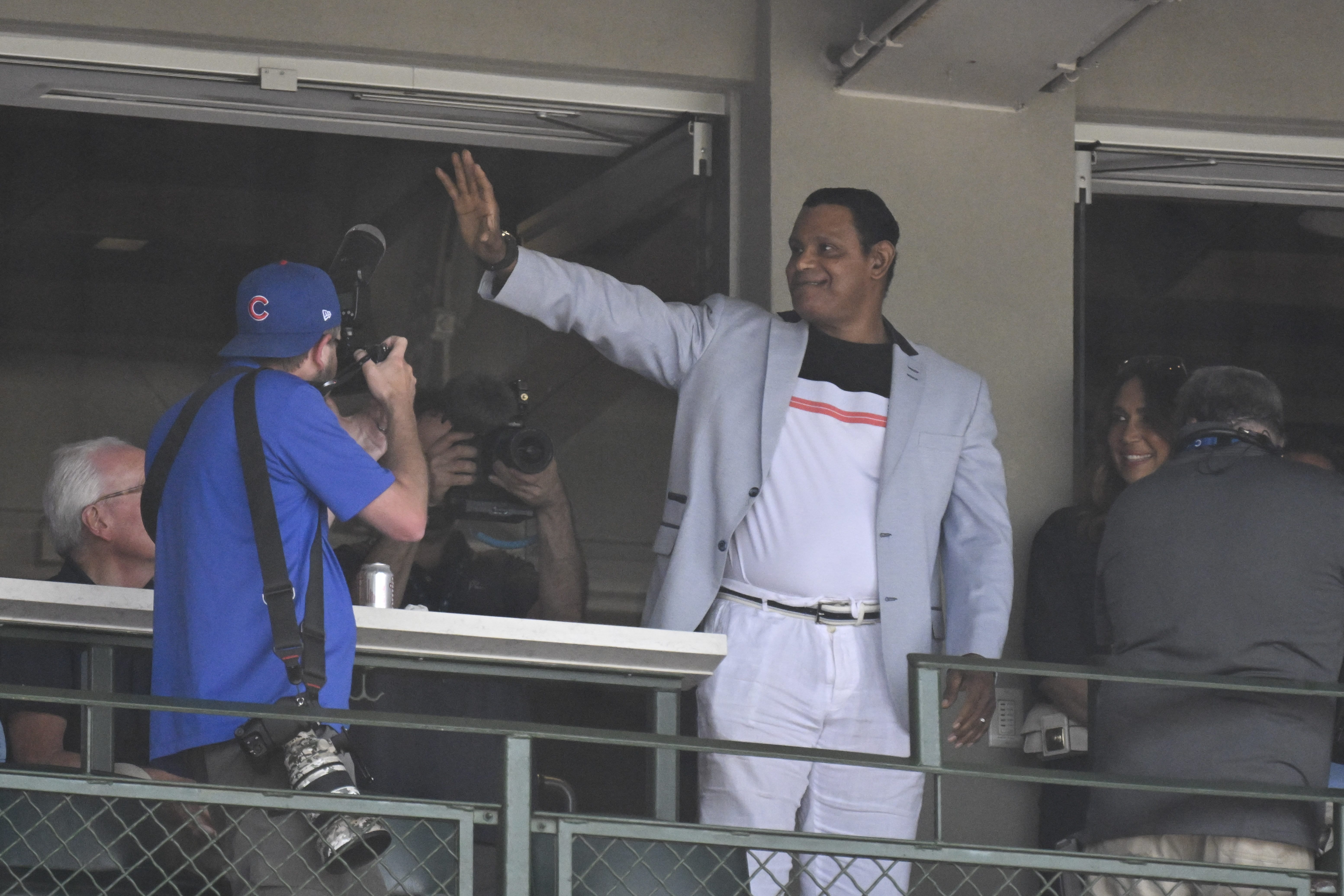
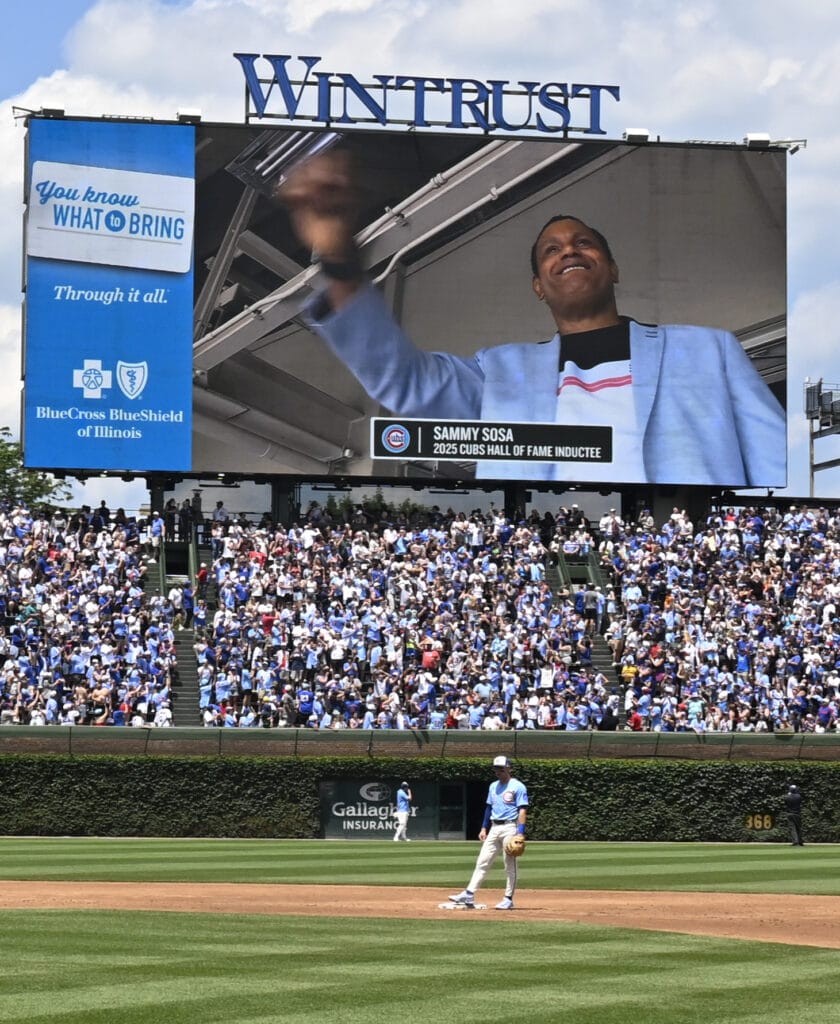
The Sammy Sosa reunion with the Cubs took another important step forward on Friday. Roughly five months after Sosa made his memorable appearance at the Cubs Convention in January, he came to Wrigley Field for the first time since the end of the 2004 season.
His return was handled the same as any notable Cubs alum; a “Legends of the Game” montage played on the left field videoboard between innings and then Sosa was featured on screen to a loud ovation.
This appearance was much more understated than at the convention in the winter, but it marked a significant step toward Sosa being re-incorporated into the Cubs organization and honored among the other Cubs greats going forward. Sosa, alongside Derrek Lee, was announced at the convention as a member of the 2025 Cubs Hall of Fame class, and he will be inducted officially the weekend of September 5. That step will signal a full end to the rift between Sosa and the Cubs.

“It’s great. I’m just happy to be back,” Sosa said Friday. “Especially the standing ovation the fans gave to me. It was an emotional moment for me.”
Sosa’s legacy with the Cubs, and in baseball as a whole, is complex. He is one of a short list of players with at least 600 career home runs, and he was a part of the home run race with Mark McGwire of 1998 that many credited with restoring some of baseball’s glory that was lost after the 1994 players’ strike. He was also accused of PED use — a charge he’s been careful to talk around, referring only to “mistakes” he’s made — he was caught with a corked bat in 2003, and he left the team abruptly at the end of the 2004 season.
The good ultimately outweighs the bad over time, at least in Sosa’s case, and judging by the reception he has received at the convention and at Wrigley Field on Friday, Cubs fans are happy to embrace Sosa, regardless of the imperfect nature of his tenure in Chicago.
Sosa is not alone in how he has been received by his former team and the baseball world. McGwire worked as a hitting coach for multiple organizations after his playing career ended, and Barry Bonds — who never tested positive for PEDs but was strongly believed to have used them — has been welcomed back by the San Francisco Giants since he retired in 2007. The PED era of the late 90s and early 2000s might be far enough in baseball history for people to take a different view of it than they did twenty years ago.
“I think that era just happened,” manager Craig Counsell said. “History happens, right?”
No period of baseball history is completely unmarred, though some eras have a much stronger negative association. And the players who were a part of those periods in baseball history sometimes have a tougher time getting back on baseball’s good graces. That’s a least a part of the reason why it took Sosa so long to be back at the Friendly Confines.
But no matter how strongly anyone feels about the negative aspects of Sosa’s life and career, it is impossible to ignore his impact on the Cubs. Wrigleyville looks much, much different in 2025 from what it did when Sosa’s time in Chicago ended two decades ago, and he was a catalyst in pushing the Cubs from lovable losers to a franchise that expects to at least be competitive, if not regularly a part of October baseball.
“Wrigley Field has always been a great place to watch baseball games. I think the nature of it has changed over the years, as everything does,” Counsell said. “I think Sammy […] was a part of it changing, and he created part of the change. Absolutely a factor in it.”
Sosa’s individual accomplishments were one thing, like his five straight All Star appearances from 1998 to 2002 and a 10.3 bWAR season in 2001, but they also coincided with a period in which the Cubs made the postseason twice in six years, something that had not happened up until that point since the 1980s. And before that, not since the 1930s. Coming to the Cubs from the south side in 1992, Sosa arrived at Wrigley at a time when the Cubs paradigm was slowly starting to shift. Not only did the Cubs eventually win a World Series in 2016, but the overall experience of going to a game has changed in myriad ways.
“When I was playing, the crowd was there,” Sosa said. “They invest at the right time, and now, Wrigley Field is a really great ballpark. The same ivy, the same field, but different.”
Sosa’s impact extends into the locker room as well. He spent some time with the team in Arizona during spring training, and though he did not address the team at Wrigley on Friday, he made an appearance in the locker room and took a picture with Pete Crow-Armstrong.
Crow-Armstrong has electrified the Wrigley faithful this season, with his bat, glove, and baserunning. He broke a record of Sosa’s on Thursday, becoming the fastest player in Cubs history to reach 20 home runs and 20 stolen bases in a season.
“Right now he’s doing fantastic,” Sosa said. “I mean, he’s swinging the bat very well. He’s already at 20-20, and he could be at 30-30, 40-40, you never know. He has the capability, he’s a smart hitter, and he uses the whole field. I believe he’s going to be tremendous.”
Like he was when he first returned to the organization in January, Sosa is hopeful that he will be able to maintain a long-term relationship of some sort with the Cubs. He said on Friday that he wants to be with the team in some capacity until he dies (“Not for a hundred more years,” he joked), but what that role might look like is unclear. Like many of the other Cubs greats, Sosa will probably be welcomed back to the winter conventions and then make periodic appearances at Wrigley Field during the course of the season. He will be incorporated into the proud group of former Cubs who have left their mark on the franchise.
“I think the fan base really appreciates guys that poured their heart and soul into this place and gave everything they had,” Ian Happ said. “That’s what makes being a Cub really special, is how much people care and how much people root for the players.”