© 2026 ALLCITY Network Inc.
All rights reserved.




Basketball’s language keeps evolving. The internet has allowed fans to be smarter, given them more resources, even created more statistical measures you’ll never find in a box score. It’s also empowered them to misuse those stats more than ever before.
The latest craze has been on-off data, which looks at an NBA team’s success when players are on or off the court. It’s inescapable when consuming basketball content online. You’ll see it cited by beat writers, analysts, and fans alike. It’s been the basis for heated arguments about Paolo Banchero and Jaylen Brown. (We’ll get to Brown later.) To the point we’ve evolved past the box score: These metrics are generated, in part, when players aren’t even on the court.
These on-off numbers can be one of basketball’s strongest statistical measures. In fact, most NBA coaching staffs track lineup data live during games, often redeploying specific players or combinations based on success they had earlier in games. This is especially true in a playoff setting; it also works in the other direction. To borrow one example from my past, the Mavericks recognized in their 2021 first-round series against the L.A. Clippers that Dwight Powell was a massive positive — but only when Ivica Zubac was on the court.

“(Powell) was a big plus in the game, but it was entirely vs. Zubac,” read one internal email sent to the coaching staff during that series outlining strategic adjustments, which was provided to me shortly afterwards by a team source. “We got outscored (by) 25 (in 12 minutes) with Powell ON and Zubac OFF (their small lineup).”
These numbers are powerful. They’re deeply respected by coaching staffs and front offices alike. But as they’ve proliferated and embedded themselves into hoops discussions, it’s also clear how easily they can be, and have been, misused. To use on-off data correctly, you must understand what it does show, what limitations it has, and what circumstances can skew these numbers. This is what you must know about it to understand when it does, and doesn’t, matter.
1. On-off data can be incredibly prone to small samples
Zach Edey played just 284 minutes for the Memphis Grizzlies this season. In those minutes, the Grizzlies outscored opponents by 113 points, which provides him with an on-court net rating — how many points the Grizzlies outscored opponents averaged over 100 possessions — of about plus-18. We can draw an obvious conclusion from this: Edey was awesome during his brief time on the court this season. That opponents managed to score just 95 points per 100 possessions in his minutes is a statistical indicator of his game-changing defensive impact, one that no other Memphis player can recreate.
Don't like ads?
It’s an indicator, however, not a measure. If Edey had played the entire season, his net rating would not have remained plus-18. If a team beat opponents by that average margin for an entire season, they’d be expected to win almost 90 games in an 82-game season. In other words, it breaks the expected wins calculator. Edey’s huge numbers speak to his impact, but we can also understand how he generated such preposterous figures: In those 11 games, he twice played against Sacramento, once against Dallas, and once against New Orleans. Those were the four games he recorded a double-digit plus-minus this season, which accelerated his stats to the unsustainable level he’s at now.
Edey might be among the league’s most impactful players when healthy. There’s no question how better Memphis was thanks to his (brief) presence. We just can’t extrapolate how impactful Edey is from this sample size. We’d need quite a few more games — against teams of different quality and with more context, like ones that play five-out basketball — to determine that.
2. On-off data works better for stars
While Edey has the league’s best on-off swings, there are names even more obscure than him that land in this season’s top-10:
| PLAYER | ON-OFF SWING |
| Zach Edey | 24.4 |
| Jose Alvarado | 22.1 |
| Collin Sexton | 21.8 |
| Elijah Harkless | 21.4 |
| De’Anthony Melton | 17.9 |
| Nikola Jokic | 17.9 |
| Hugo González | 15.7 |
| LaMelo Ball | 15.4 |
| Walker Kessler | 15.2 |
| Jamison Battle | 14.9 |
Jose Alvarado and Collin Sexton both benefit from joining new teams. For Alvarado, he’s joined New York right as the team has put together its most impressive stretch of the season, but his on-off numbers now include the minutes he was “off” the court earlier this year when the Knicks had rougher stretches. He’s been a useful addition, no doubt, but he hasn’t driven New York’s recent success. The team has just played better. Likewise, Sexton is a competent veteran guard that has played well mostly off the bench for Chicago. His numbers are inflated when compared to the entire body of Chicago’s work this season.
The same applies to Elijah Harkless, De’Anthony Melton, and Hugo González. No one thinks these players impact winning more than, say, Giannis Antetokounmpo. (His on-off swing ranks 11th.) We do believe that about Nikola Jokić, however, because we know he impacts every possession, touches the ball nearly every trip down the court, commands gravity from every opponent’s defensive scheme. We can reach the same conclusion for LaMelo Ball. While Charlotte’s success has been multifarious this season, we can conclude from these numbers he’s what most fuels their success.
This calculation works for defensive stars, too. Anthony Edwards doesn’t have gaudy on-off numbers this season: Minnesota actually outscores opponents slightly more when he’s off the court. That feels odd, at first, given Edwards is the league’s third-leading scorer on well above average efficiency this season. But the on-off numbers confirm his offensive impact: Minnesota scores five fewer points per 100 possessions without him. But the Timberwolves are better on the court’s other end without him. That’s the Rudy Gobert effect. With Gobert on the court, the Timberwolves allow more than 11 fewer points per 100 possessions.
Don't like ads?
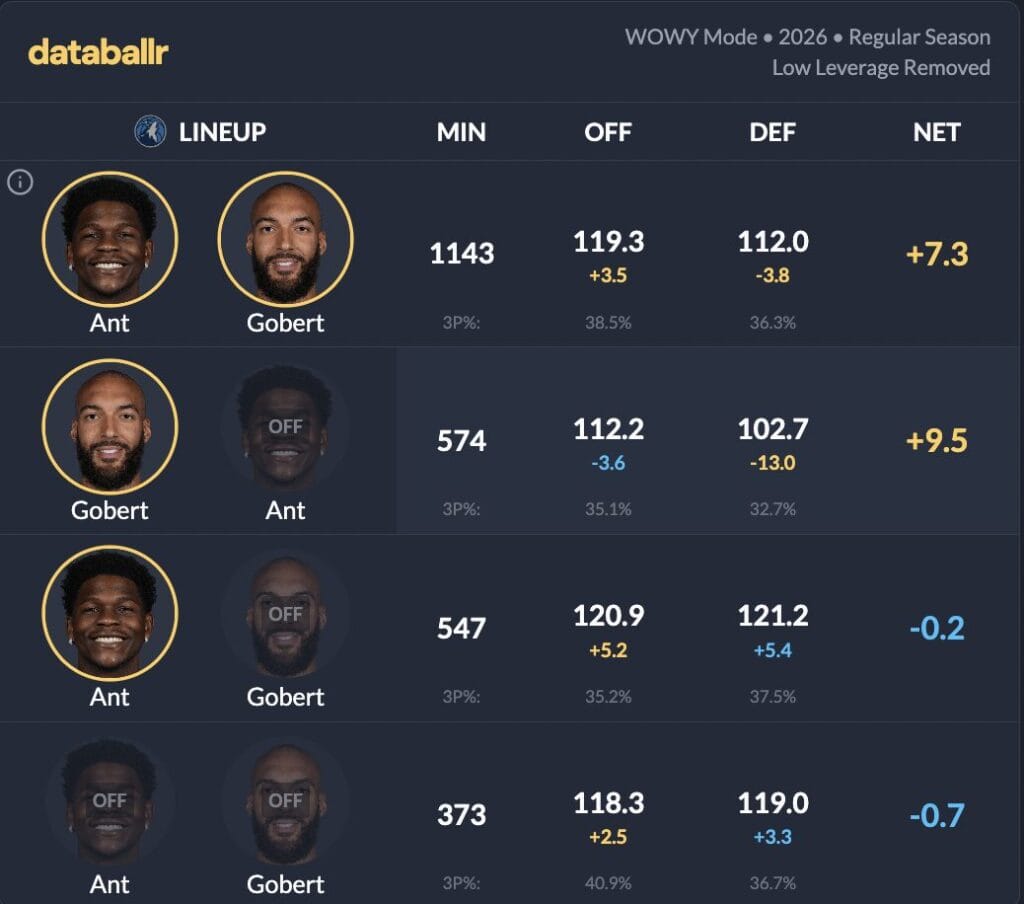
This doesn’t even mean Edwards has been a bad defender this season. It means only that he doesn’t have Gobert’s game-altering impact. It means Minnesota can replicate Edwards’ transcendent offense more easily than it can Gobert’s special defensive presence.
These are safer conclusions to draw than those involving role players. It’s easier to measure what transcendent players do — because their impacts, inherently, aren’t replicable — because it’s felt more severely and meaningfully when they play. But these numbers also speak to the rosters around these transcendent players. A superstar point guard should always have positive impact metrics, but on-off numbers can often swing wildly based on how good his backup is.
3. On-off data is heavily rotation- and role-dependent
Role players are difficult to measure because they often fill different roles. Go put an otherwise excellent 3-and-D wing into a lineup without an offensive creator, and those lineups will likely struggle because that player isn’t being deployed to his strengths. Great shooters, even role players like Sam Merrill and Duncan Robinson, will always create positive on-off swings on the offensive end due to their gravity. But there’s a reason Detroit’s offense is about the same with just one of Cade Cunningham or Robinson on the court. It’s only when those two play together that we see a positive spike. (And, when neither are on the court, a negative one.)
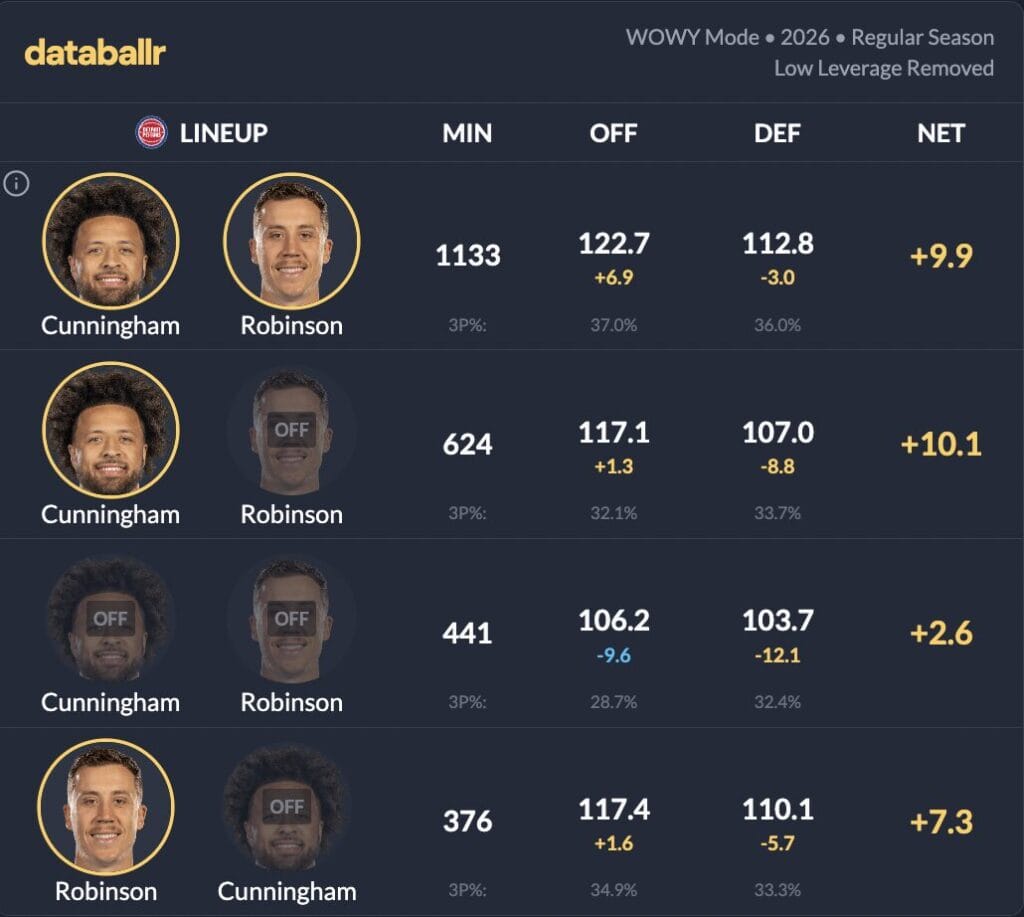
All that matters. San Antonio’s best role players, at least according to their on-off numbers, are the ones who play most often with Victor Wembanyama. In fact, San Antonio might even value a player who can raise the team’s floor when Wembanyama isn’t on the court more than a player who meshes well with him. Because Wembanyama’s presence amplifies anyone around him; it’s the minutes without him that San Antonio more urgently needs to solve.
This brings us to the Jaylen Brown conundrum. How can we explain this?
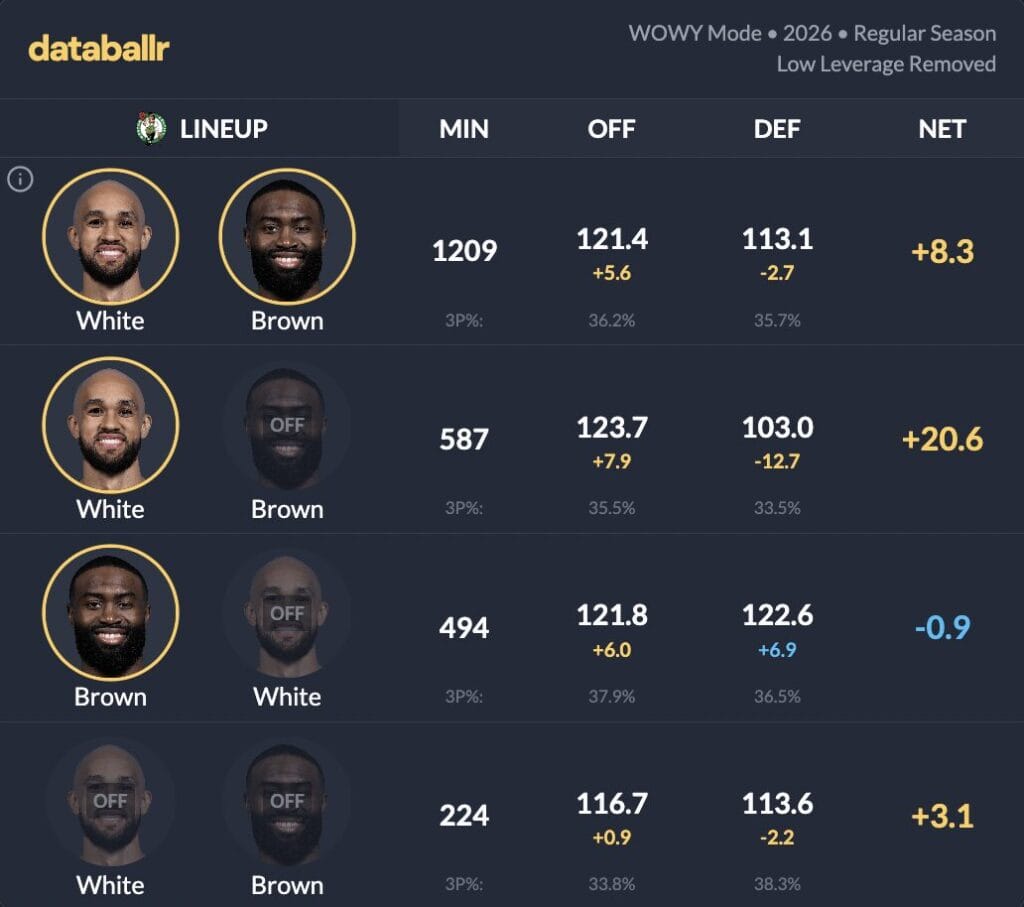
Is Brown the Celtics’ best player? The obvious impulse is to say yes, of course, because he’s the player who has buzz for the All-NBA First Team and, at least from a select few, the MVP race. The impact metrics, including and beyond on-off data, massively prefer Derrick White. Those metrics, like estimated plus-minus, are highly attuned to on-off data. Their numbers are also often misrepresented as a ranking: That, because White has the league’s 12th-highest estimated plus-minus this season, he’s the league’s 12th-best player.
Don't like ads?
It’s more accurate to describe these metrics as saying White has had the 12th-most significant impact on winning this season, which contains notable nuance from the first statement. These metrics are fallible, imperfect. They also say, based on an egregiously small sample size, that Ty Jerome has had the same offensive impact this season as Jokić. But there’s a reason that many front office executives believe estimated plus-minus is the most accurate catch-all metric. What it has indicated about Brown is worth the time to try to understand.
We all understand a team’s leading scorer isn’t necessarily its best player, which we most often see on teams with dominant two-way centers. No one believed Tony Parker was San Antonio’s best player even when he averaged more points than Tim Duncan, for example. (This season’s closest parallel is likely Bam Adebayo mattering more to the Miami Heat than Norm Powell or Tyler Herro.) We also understand Duncan couldn’t play Parker’s role. It’d be nonsense to think that.
This concept becomes blurrier when comparing players that are more similar. Brown and White feel more interchangeable because they’re both guards with guard-like skills. Both can create shots and run pick-and-rolls. But Brown, obviously, is Boston’s lead creator this season. He’s the player most often tasked with the team’s first attempt to disorganize opposing defenses and with taking lower percentage shots, which every offense must sometimes do, because he has more shotmaking talent.
It’s just that, according to the numbers, that shotmaking talent isn’t so exceptional that it’s driving Boston’s success this season. It’s a necessary role, make no mistake. Someone should be the head of the snake in any offense; most lineups have a player designated for that oh-shit-let’s-run-a-bailout-iso role, even blowout end-of-the-bench ones. Because shotmaking talent is one of the league’s most rare and important skills, these players are deemed the best, drafted high in the lottery, and command the league’s heftiest salaries.
Until Jayson Tatum returns, Brown is the Celtics’ best option to fill that role. White couldn’t fulfill that role as well as him; he’s better suited to be the team’s secondary creator and being someone who expends more energy on the defensive end. When he does lead the offense, it’s often against second units or against more favorable matchups. (Brown’s role is to create shots even if there isn’t a matchup advantage.) More players have the skills to fill White’s role. It’s just also true that virtually no player can replicate how much impact White creates within that role.
This is the contradiction often missed: Brown has a more unique talent, which has always been associated with the league’s best players. Boston likes when he takes mid-range jumpers, even if he’s only making 43 percent of them, because it draws defensive attention to him and meshes synergistically with the team’s board-crashing philosophy. If Brown was more efficient in this leading role — his 57.2 percent True Shooting is the worst among top-20 scorers — he would have a more visible impact on Boston’s success. He’s still the player best suited on the Celtics roster to fill that role, which someone must.
Don't like ads?
Boston also has some dominant bench lineups that White, not Brown, has more opportunities to take part in. Because the Celtics have more useful role players than they can even play when fully healthy, they often build leads against opponents’ second units. There’s no doubt White heftily contributes to that. He elevates everyone around him. But those rotation patterns fuel these stats, too.
It’s also reasonable to conclude Brown’s defensive impact has waned from previous years due to his offensive focus. (You could even argue his defensive impact was always overstated, but that’s beyond this story’s scope.) That’s one more explanation for his unimpressive numbers.
These on-off numbers don’t claim Boston would be better off without Brown, though. Someone much less capable would have to assume that lead scorer role, which would hurt everyone on the team over the season’s entirety. But while he sits atop the team’s hierarchy, performing a needed role for the team’s formula, it’s everything around him that has most driven this season’s success.
4. On-off data does work well with platoons
Here’s one type of role player where on-off numbers work great: Non-scoring centers.
Take the 2023-24 Mavericks, who traded midseason for Daniel Gafford and eventually started him over Dereck Lively II en route to the Finals. Both Gafford and Lively served as workhorse big men who operated offensively as extensions of Luka Dončić and Kyrie Irving. They existed as a platoon, each filling the same role when the other sat, never overlapping, which provides more statistical significance when these players’ on-off numbers in those playoffs were this:
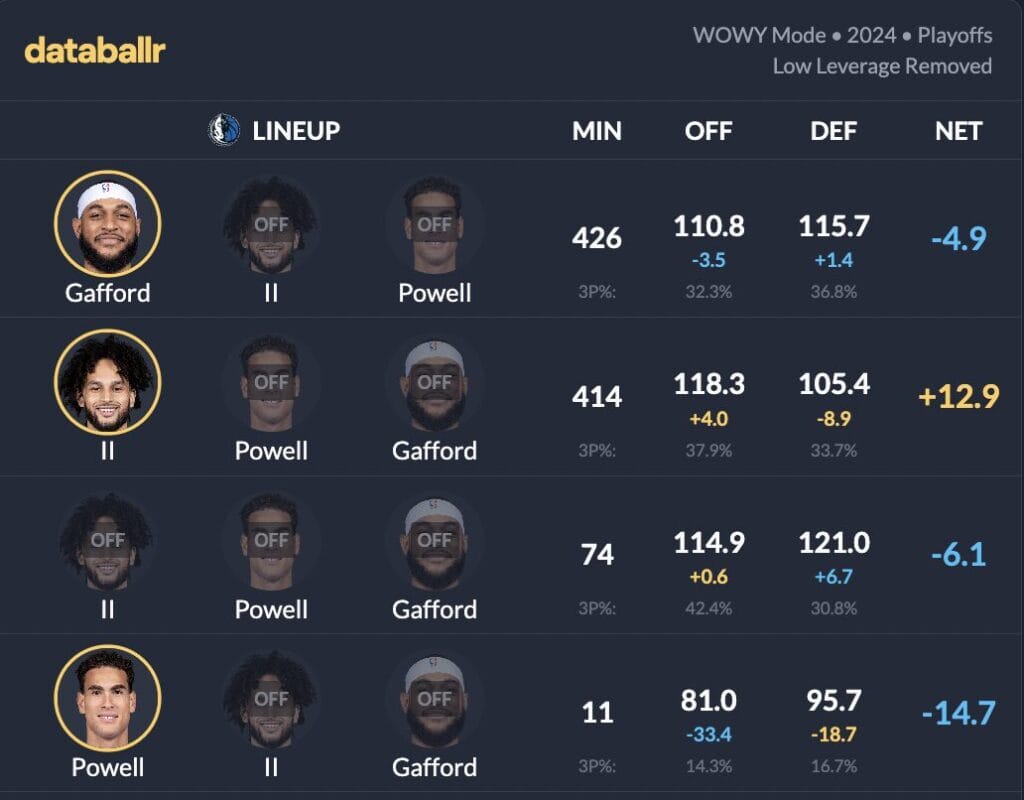
Even though these players generated similar counting stats, Lively had a much clearer impact on the team’s success. He didn’t record quite as many blocks, but his defensive awareness and mobility forced opponents into tougher shots more often. Gafford was a more effective finisher around the rim, but Lively’s decision making had a greater impact on the team’s offense than however many layups he missed that Gafford might have finished.
Don't like ads?
Even then, because Lively came off the bench and faced more second units, it would still be responsible to make sure those numbers weren’t inflated because Dallas dominated the second units they faced. It would be necessary to make sure Lively’s minutes weren’t boosted due to an outlandish 3-point variance — i.e., open 3s simply didn’t go in, which often boils down to pure dumb chance — while the Gafford lineups were bombed.
But this trend continued into the following regular season. It happened again this year before Lively underwent season-ending surgery. These two players have combined to play 4,500 regular season minutes in Dallas. The Mavericks have significantly won Lively’s minutes while treading water in Gafford’s across many different contexts and lineups. It’s safe to state Lively has a greater winning impact than Gafford despite the obvious skills Gafford brings to the court.
Just don’t do this.
It’s almost certainly true Nikola Vučević will be a better player than Luka Garza, which explains why he instantly supplanted him in Boston’s rotation. Let’s not use on-off data to make that point, which we can just as easily do with our own eyes, after he has played only 58 minutes.
5. On-off data isn’t going anywhere
Because on-off data can show the hidden impact players have on the court, ones that box scores aren’t equipped to measure, we’ll keep using them. We knew Charlotte was better than its record earlier this season because, when Ball played with Kon Knueppel and Brandon Miller, the team was dominant. Now that the Hornets finally have them healthy and playing together, we’ve seen that translate to the court.
It’s also become easier to find them thanks to sites like Databallr, which I used for most of these screenshots. I appreciate that Databallr includes both minutes played and 3-point percentages in its incredibly shareable screenshots, numbers which should deter some of the worst use cases for on-off data. These sample sizes still shrink even further when comparing multiple players at the same time; they can be more easily influenced by a team’s recent schedule.Which is to say: On-off data matters if you know how it can be skewed. Understand these numbers might say more about a team’s rotation patterns, its depth, and which players actually have irreplaceable skillsets than it does about the individual’s impact. And please, for the love of God, don’t draw conclusions from 58-minute sample sizes.
Get Chicago's Best Sports Content In Your Inbox!Become a smarter Chicago sports fan with the latest game recaps, analysis and exclusive content from CHGO’s writers and podcasters!
Just drop your email below!
Comments
Share your thoughts
Join the conversation

The Comment section is only for diehard members
Scroll to next article

Don't like ads?
Don't like ads?