© 2026 ALLCITY Network Inc.
All rights reserved.


MILWAUKEE — The last two games of the Cubs‘ 2025 season typified what this team could look like when they were at their best and what they could look like when they weren’t. Game 4 provided one of the most electric environments at Wrigley Field in close to a decade, and two nights later Game 5 brought the final disappointment.
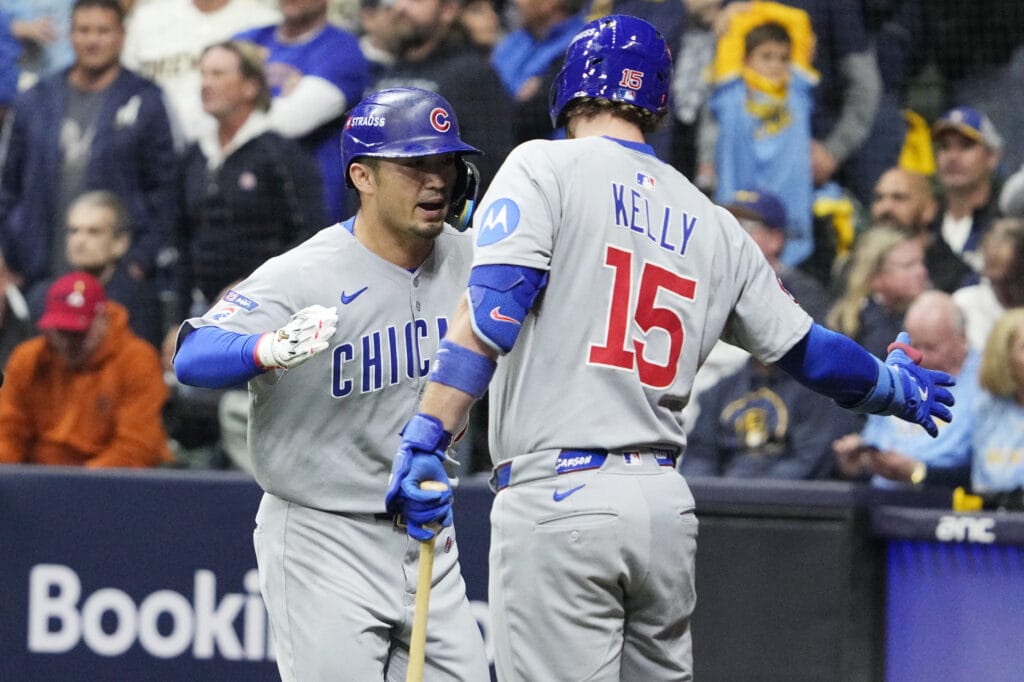
In Chicago on Thursday, the Cubs were resilient and merciless in all facets of the game. They punished Brewers pitching early, stifled every run-scoring opportunity defensively, and every pitcher called upon delivered. Then the Cubs’ short but intense playoff run came to an end in Milwaukee on Saturday night. A second inning solo home run by Seiya Suzuki didn’t prove to be sufficient offense, and the Cubs lost Game 5 and the series to the Brewers.
Much was made of the gamesmanship of the pitching plans for the two teams going into the game, with neither club announcing a starter until Saturday. The Cubs and Brewers both elected to use openers and then play a game of matchups from there, which meant the deciding factor was going to be which offense found the right spots to do damage.

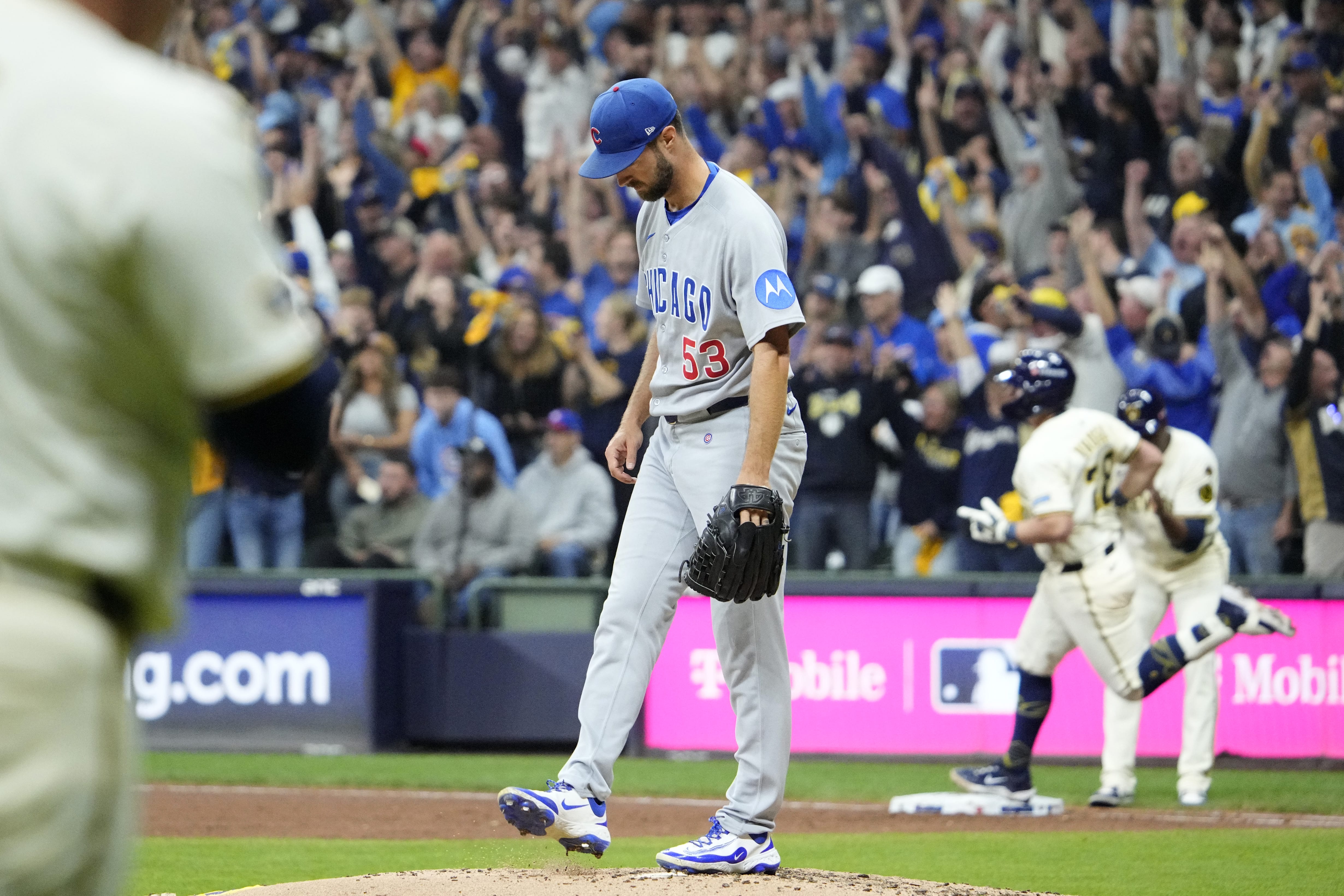
In the Brewers’ case, it was hitting a trio of solo homers — each one when there were already two outs — and as for the Cubs, they could not string together quality at-bats and squandered the one real scoring opportunity they got when Kyle Tucker, Suzuki, and Ian Happ went down in succession with two runners on base in the sixth inning.
Cubs manager Craig Counsell knew the offense would be the key to winning or losing, saying before the game that his team would have to put together quality plate appearances in order to win and move on to the next round.
“We’ve got to have good at-bats. We’ve got to win pitches,” he said presciently. “I think the bullpen games, blowing up the plan, as much as you can and try to introduce some chaos to that plan is offensively how you can derail it. But in the end, it’s just win pitches, have great at-bats, put pressure on them.”
And that’s precisely what the Cubs offense didn’t do.
Most glaringly, in Tucker’s sixth inning at-bat. With no outs and two runners on, he got ahead 3-1 and had a chance to flip the game when Aaron Ashby absolutely piped a four-seam fastball in the heart of the strike zone, and Tucker fouled it off.
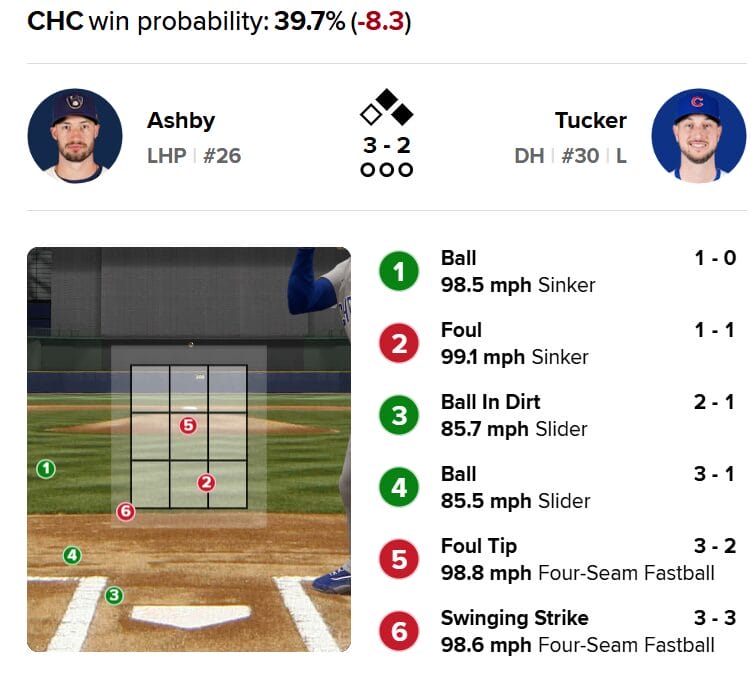
That was the spot, that was what should have been the moment.
“That was the inning. That was the inning with the middle of the lineup up,” Counsell said. “It’s really the only inning you could talk about. We just didn’t do much. We had six base runners. You’re going to have to hit homers to have any runs scoring in scenarios like that.”
The Brewers pitching staff deserves credit because they made few mistakes and with only the one exception in the second inning when Suzuki homered, the Cubs never really capitalized on the chances they did get, like the 3-1 pitch to Tucker.
“Situations like that you just have to try and take advantage and capitalize on [them], but they have some really good pitchers [and] made some really good pitches when they needed to and got out of that spot,” Tucker said.
Milwaukee rookie Jacob Misiorowski earned the win, pitching four innings following opener Trevor Megill’s frame. After Suzuki’s leadoff home run in the second inning, Misiorowski retired 12 of the other 14 batters he faced. Though he is known for his triple-digit fastball, Misiorowski fed Cubs batters a steady diet of breaking pitches, an adjustment he made because of Suzuki’s blast.
“Suzuki jumping on that heater and kind of realizing, oh, that’s what they’re going to go with,” he said of the move away from his fastball.
It was to be expected that in a bullpen game neither team would generate a lot of run-scoring opportunities, and that probably should have favored the Cubs. If the game was going to be decided on who hit more homers, there was a clear advantage: in the regular season, the Cubs ranked 6th in baseball in home runs, and the Brewers were down at 22nd. In 162 games, they outslugged Milwaukee by nearly 60 homers, but when it counted most, the Brewers hit two more than the Cubs.
Days like that are going to happen during the course of a baseball season, and when they come during the first 162 games, they are usually just irksome, but when they come on the last day, it ends a playoff run and a season.
That said, 2025 provided a lot of reason for optimism about the future of the Cubs. They improved by nine wins over the past two seasons and reached the playoffs for the first time in a full-length season since 2018. They won a playoff series for the first time since 2017. They clinched a postseason series at home for the first time since a year before that.
“You’ll take that every single year. I think every team would,” Counsell said. “The playoffs are a different animal. It’s completely different than the season, totally different.
“Ultimately, the reason why you want to win 92 games is because you want to play in a World Series and win a World Series. And we should have those expectations. We should have them every year.”
In the weeks to come, the Cubs’ front office will turn the page to 2026 and work on how they’ll get back to the postseason and take another shot at the World Series. There will be some changes; key bullpen pieces Brad Keller, Drew Pomeranz, and Caleb Thielbar are all set to be free agents, and the Cubs have only one more year with Nico Hoerner, Suzuki, Happ, and Jameson Taillon guaranteed on the roster. And, of course, there’s the Tucker question.
He was the big offseason acquisition this past winter, but the trade for Tucker was made knowing that he would be seeking a top-dollar, long-term contract with someone after this year. His asking price may have dropped a little because of a drop in his power numbers this year — Tucker posted the lowest slugging percentage of his career in 2025 — but he will still likely be expensive, and it’s not safe to assume he will give the Cubs a friendly discount.
“We’ll see what happens,” Tucker said about his impending free agency. “Don’t know what the future is going to hold, but if not, it’s an honor playing with all of these guys, and [I] wish everyone the best of luck, whether it’s playing [together] next year or not.”
The good news is the Cubs have the outfield depth in their system to fill the void Tucker will leave, and both of the guys lined up to do it, Kevin Alcantara and Owen Caissie, got some major league experience in 2025 and were with the team during the playoff run this fall.
There are those two and several other young players already on the major league roster who gained a lot from the experience of the past two weeks. Next season, that coupled with the healthy returns of pitchers Justin Steele and Cade Horton to the rotation should make for a 2026 campaign that builds off of the success of this year.
For as disappointing as the finale was, just getting to play in these eight postseason games will do a lot for the young core of the team. Happ, who was a part of the 2017 and 2018 teams when he was in the beginning of his career, can attest.
“I fell in love with this city and this fan base and being a Cub because in my first year we went all the way to the [championship series], and that was with a group that had experienced a ton of winning,” he said. “I saw that atmosphere. I saw what those guys got to see. Those playoff games at Wrigley, I knew how special it was, and I had guys, veteran guys, that told me how special it was. [They] said, ‘Hey, it’s not always greener. This is a pretty special place,’ and I really took that to heart.”
So while the loss on Saturday night might sting, the long-term gain could be worth it. Some of the players from the 2025 Cubs team will inevitably move on, perhaps because they retire or sign somewhere new, but there will remain a group of them who will have a little something extra to play for in 2026 because of what they have just gone through.
“I think a lot of those guys got to experience that, a lot of those guys got to experience how special it is,” Happ said of being in the playoffs. “And it never ceases to amaze me when veteran players who have been all over the place come here and have a full season here, parts of a season here, and at the end of the season they’re saying, ‘Hey, this is the most fun I’ve ever had playing baseball.’
“I’m lucky to have only been here. I’m lucky to have only worn this uniform for as long as I have, and it really is just a truly special place.”