


Noah Schultz is just five years removed from taking his SAT, so he can be forgiven for having a bit of nerves during his major league debut on Tuesday night. Schultz pitched his high school innings at Oswego East, roughly 40 miles from Rate Field. He’s the first pitcher the White Sox have taken out of high school in over two decades. During his quick rise through the minor leagues, Schultz drew comparisons to pitching luminaries like Randy Johnson.
His debut was pumped up for days, the news of his impending arrival in Chicago first breaking over the weekend. Tuesday was, in many respects, “Noah Schultz Night,” complete with social media hype straight from the team. By the time Schultz took the mound, the wait for his first pitch had felt interminable.
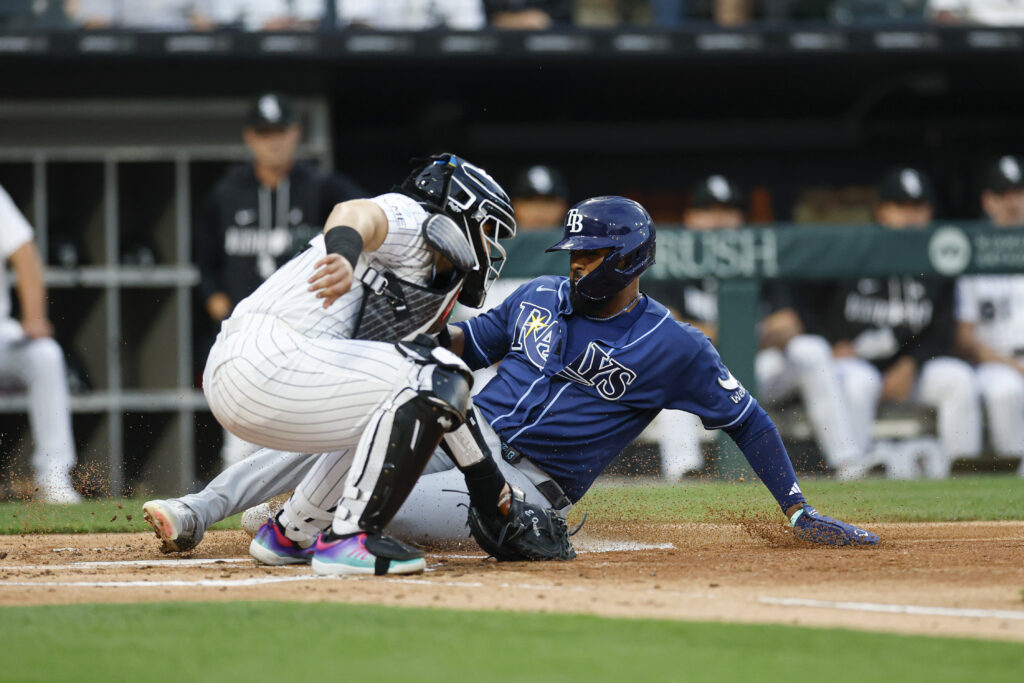
Schultz started off with a called strike, met with loud cheers from the Sox faithful. From there, MLB Pipeline’s number two prospect in the White Sox system battled through a rocky first inning against the Rays. They ultimately tagged him for four runs — three earned, one run came on an errant throw to home by Schultz — but Schultz punctuated the inning with a commanding strikeout against Jonny DeLuca. A hopeful sign of things to come.
To his credit, Schultz responded later in his start, but the challenging first inning was a product of both some understandable nerves and not having his usual feel for his breaking pitch.
“I definitely didn’t have the slider tonight, so that was something I learned after the first inning,” Schultz said. “I just had to use the other pitches I have, and I’m happy to have those at my service whenever I need.”
Control was an issue in that first inning; at one point Schultz threw seven straight balls. And when he found the zone again, Ryan Vilade rewarded Schultz with a double to left field. What eventually helped Schultz get through the inning and from there through the rest of his outing, catcher Edgar Quero said, was figuring out how to work around his slider.
“It definitely buried a lot of the game plans against some of the hitters that the slider wasn’t there,” Schultz said. “But I think we did a good job talking between innings, gameplanning, switching things up after learning every time facing the guys.”
Quero said getting ahead of hitters and controlling the zone with Schultz’s cutter helped with his nerves and his confidence as the game went on, and later in his start, Schultz started to get a better feel for his four-seam fastball too.
Getting through the normal, major league debut nerves came in part from battling past the first inning, but Schultz said the support of his teammates went a long way as well.
“After the first inning, it was a lot easier to settle into stuff,” Schultz said. “A lot of nerves, you know, calm down a little bit. I can’t thank the guys in the dugout enough for helping me get through that. Helping me [by] saying they’ve had similar experiences.”
Schultz’s catcher was one of those guys. Quero made his own debut on April 17 of last year, so he still remembers well how that felt.
“It’s a different feeling,” Quero said. “It’s a lot of things coming through your mind and your feelings. But I’m happy to have him right here, right now.”
Schultz logged a three up, three down second inning on just 11 pitches. Tampa Bay scored one more run in the third on back-to-back base hits, but even that damage was limited because Schultz made up for his first inning throwing gaffe by deftly throwing out Junior Caminero at third base during an attempted double steal.
Schultz pitched a mostly clean fourth and then finished his night by striking out Jonathan Aranda looking in the top of the fifth. After the first inning, Schultz allowed two base hits and two walks and notched three of his four strikeouts. In all, a respectable outing with plenty of reason for White Sox fans to feel good about Schultz’s future.
“I thought it was overall really good,” manager Will Venable said. “Understandably, the first inning sped up on him a little bit there, [and Schultz] wasn’t in the zone like we saw him later in the game. But he did a nice job settling down and good us to a good spot and gave us a chance to stay in the ballgame.”
Schultz’s next turn in the rotation will likely come in a week, when the White Sox are in Arizona. That’s an environment where it should be a lot easier to avoid pregame jitters, both because it’s on the road and because his home stadium is a short drive from where he pitched in high school.
In his reflection on Tuesday’s outing against the Rays, Schultz stressed his eagerness to get to work in the days between his debut and his next start. Based on his debut, just having a better feel for his breaking pitch in his next start will improve things significantly for Schultz. Pitchers can lose feel for a pitch during an outing without that being a sign of a larger problem, and it’s probably the case that this was just an off night for Schultz with his slider.
The fact that Schultz went through adjusting his game plan on the fly against major league hitters bodes well for his future. That’s a valuable and crucial learning experience for any young pitcher, and it’s often one that, if they fail, it can make a brutal introduction to the majors.
As for what his long-term trajectory might entail, Schultz has a very high ceiling, and the next few weeks will do a lot for continuing to push him closer to it. As the Sox are sorting through other areas of the ballclub in their effort to put together a season that is a clear step forward from last year, Schultz is a pitcher who can not only stabilize the rotation, but one day lead it.
“The sky‘s the limit for him, man,” Quero said. “There’s not many guys like him right now in the big leagues.”