

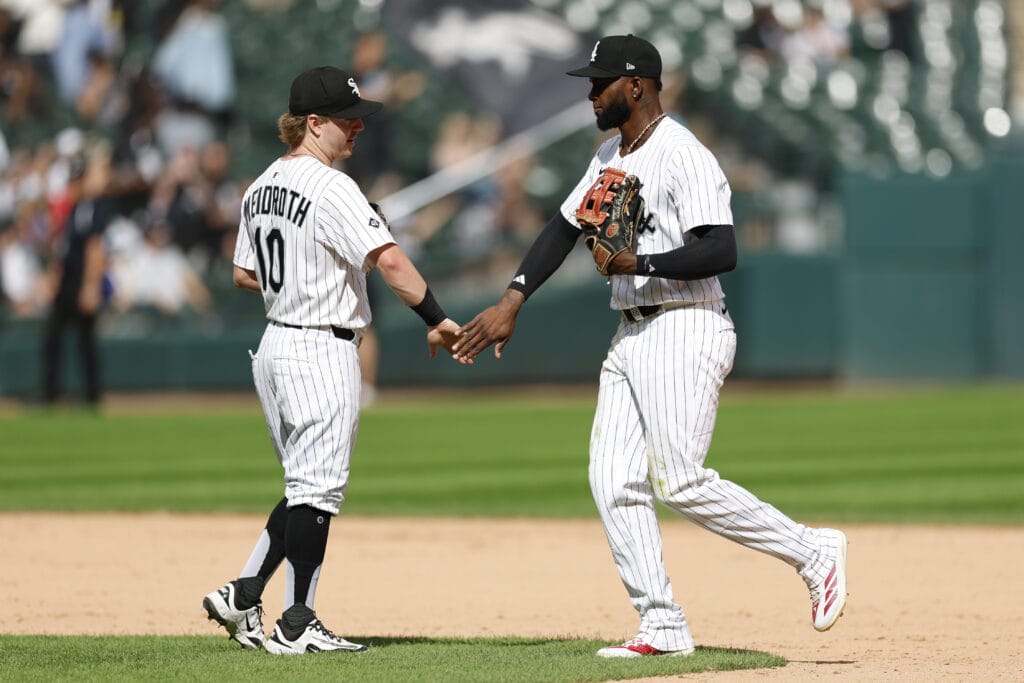
The last vestige of the briefly competitive 2020-2021 White Sox, a product of Rick Hahn’s rebuild initiated in 2017, is now on his way to the New York Mets. As announced first by ESPN’s Jeff Passan late Tuesday night, Luis Robert, Jr. is headed to the Mets in exchange for Luisangel Acuña and minor league pitcher Truman Pauley.
A trade of some sort involving Robert, Jr. has felt a long time coming. During his White Sox tenure that started in 2020, he showed flashes of greatness but was ultimately hampered by injury. A healthy Robert, Jr. is someone capable of carrying a franchise on his back, but it had been clear for a while that his body might never hold up to that task or that if it did, the White Sox were not the franchise where he might play his best seasons.
Like it or not, that’s the reality, and with Tuesday’s trade, the White Sox have moved on.
The question going forward is how the White Sox keep moving in the right direction without Robert, Jr. in the lineup. Though he arguably had just one complete season, in 2023 when he was an All Star and earned the Silver Slugger award while posting an .857 OPS, Robert, Jr. was still a valuable piece in the White Sox lineup. Last season, in a down year, Robert, Jr. was still worth 1.3 fWAR because while struggling at the plate, Robert, Jr.’s defense in center field was consistently good, which helped keep his value up.
The return for Robert, Jr. won’t fill the void in center field, though Acuña has exciting potential. He’s the younger brother of 2023 National League MVP Ronald Acuña, Jr., and in short stints in 2024 and last season, he looked like the kind of hitter who could produce like Robert, Jr. did when he was healthy. The younger Acuña had 5 extra-base hits and a .966 OPS in 40 plate appearances in 2024, and though his performance dipped last year, Acuña showed power and speed potential.
The problem is that Acuña’s experience thus far is as an infielder — primarily a second baseman — so the void manager Will Venable will have to figure out how to fill is in his outfield. That said, there’s a possibility Acuña will make the move to center field himself. He has just three innings of major league experience there, but making the move from middle infield to the middle of the outfield is easier than the reverse. On top of that, the White Sox have much less of a need in the infield, so a defensive transition for Acuña might be the smartest move to give him ample playing time and give the White Sox a steady center fielder now that Robert, Jr. is gone.
Take a look around the infield as it stands on the current White Sox roster, and moving Acuña to center field begins to make sense. Miguel Vargas and Munenori Murakami will occupy the corner spots, and up the middle Chase Meidroth and Colson Montgomery are pretty firmly entrenched. Assuming Acuña is expected to be a regular in the lineup, he could end up being Robert, Jr.’s replacement in center field.
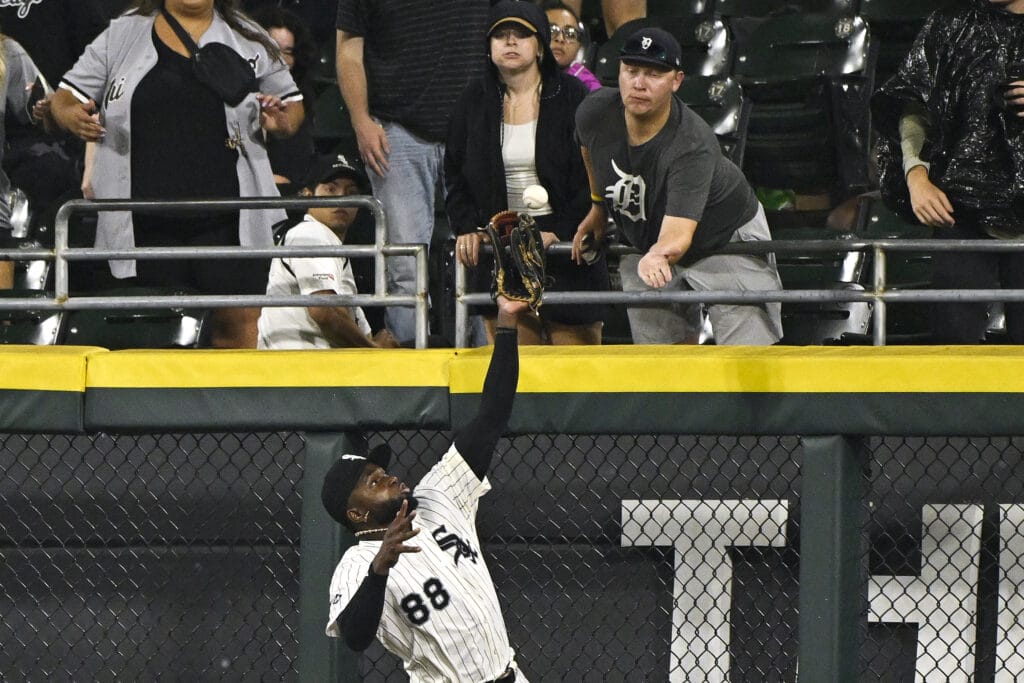
If Acuña is not the option at center field, then White Sox fans should prepare for a season of plug-and-play options. They claimed veteran center fielder Derek Hill off waivers from the Marlins last September when Robert, Jr.’s latest injury had sidelined him for the reminder of the season. This offseason, the White Sox have made moves to acquire outfielders Everson Pereira and Tristan Peters, both guys who can play center field when needed, and Jared Kellenic is in the organization on a minor league deal.
Beyond that group, the White Sox don’t have the organizational depth to address the center field hole left by Robert, Jr. from within, at least not in 2026. Outfielder Braden Montgomery is the top-ranked prospect in the system, but he’s at least a year away from being major league ready and is probably better suited for right field anyway.
There were different opinions about when the best time was to trade Robert, Jr. It’s possible that they could have waited until the July trade deadline and gotten a slightly better return, but that option would have come with the risk of Robert, Jr. getting injured or underperforming in the first half of the season and torpedoing his value.
Whether they shipped him away now or in July, it was evident that the future of the White Sox was not going to include Robert, Jr. He was an exciting piece of the rebuild project that reached its pinnacle in the 2021 division series, but ultimately Robert, Jr.’s legacy in Chicago will be of a dynamic and potential-filled outfielder who really only gave White Sox fans one truly good season.
An optimistic look forward would be a future where Acuña becomes a key member of the next competitive White Sox team, and that’s a reasonable projection. There’s also the money that comes off of the books with Robert, Jr. off of the roster, and ideally, something would be invested in strengthening the White Sox rotation. Even with Acuña in the outfield, that group isn’t strong, but the White Sox have greater need on the mound.
The White Sox chapter of Robert, Jr.’s career is over, and although he should largely be judged as a disappointment, general manager Chris Getz managed to fetch a return for him that could yield real value for the team going forward.