

I am not “numbers” smart. I took the one math class required in college for a communications major. But I wanted to make sense of the Chicago Blackhawks‘ start to this season from a goal-scoring analytics perspective. I am 100% in over my head, but I think I am onto something.
From a birds-eye view, the numbers suggest that the success the Blackhawks have found this season is unsustainable with a high team shooting percentage, a high team save percentage, and low offensive chances created percentages.
We are still early into the season, but we are close to the quarter-mark of the season, and by then, it’s about the time when we get a good understanding of who teams really are.
If there were some sort of PDO “crash” coming for the Blackhawks, analytics suggest it would be soon. But it hasn’t happened yet and I get the sense it might not happen given the way the Blackhawks have played this season under head coach Jeff Blashil.
This team is not lighting up opposing goaltenders with shots this season, ranking in the bottom-third of the NHL in shots on goal per game, but that’s not the mentality Blashill has for his group.
“I would say philosophically, we aren’t a team that says, overshoot, overshoot, overshoot,” Blashill said after Wednesday’s morning skate. “It’s not to say look for the next play, we’re not saying that necessarily, either…I think sometimes it can cloud people’s vision of how the game’s being played when you get outshot a lot. I always hear from people, ‘Oh, you got really out-played.’ Then you look at chances and they were 4-4. You didn’t get out-played, you got out-shot. There’s a difference.”
While their 8-5-3 record and 19 points in the standings put the Blackhawks in the Western Conference wild card, there is still skepticism that being near the bottom of the league in shots for and shots against per game is not a winning strategy.
Are the Blackhawks lucky to be where they are, or is there a concerted “quality over quantity” effort going on?
“I don’t know the exact reason and I don’t want to give away too much, but that is a nice sign for us and it has to continue. We have to make that sustain for as long as we can.” Blackhawks captain Nick Foligno said.
“Honestly, it’s a great question. If I could answer it, I think other teams would start trying to do it too.” Ryan Donato said after a processing pause, once I finished throwing these data points at him.
Without trying to give away any of the Blackhawks’ “secrets” to success this season, when you dig into the numbers, they suggest the Blackhawks are one of the best teams at “finishing” this season.
OK — here we go with the numbers…
Scoring & Finishing
Shots on goal per game: Blackhawks rank 28th (25.2)
Shooting% (5-on-5): 5th (11.01)
Shooting% on unblocked shots (5-on-5): 6th (7.11)
Expected Goals% (5-on-5): 28th (45.9)
Actual Goals% (5-on-5): 3rd (58.06)
Goals For above expected (5-on-5): 6th (2.15)
Rebound shots for (5-on-5): 14th (44)
Rebound goals for (5-on-5): T-3rd (6)
High-Danger Goals: 3rd (31)
High-Danger shooting%: 1st (26.72)
When you’re hot, you’re hot, right?
“But what is hot?” Donato asked as I brought this point up to him.
If the Blackhawks were scoring their goals from long range with beautiful snipes constantly, sure, you could chalk it up to guys who are feeling it and their shots are finding the back of the net. But that’s not the case.
The Blackhawks are one of the best teams in the NHL at getting to the most dangerous areas of the offensive zone and burying the puck when they get their chances.
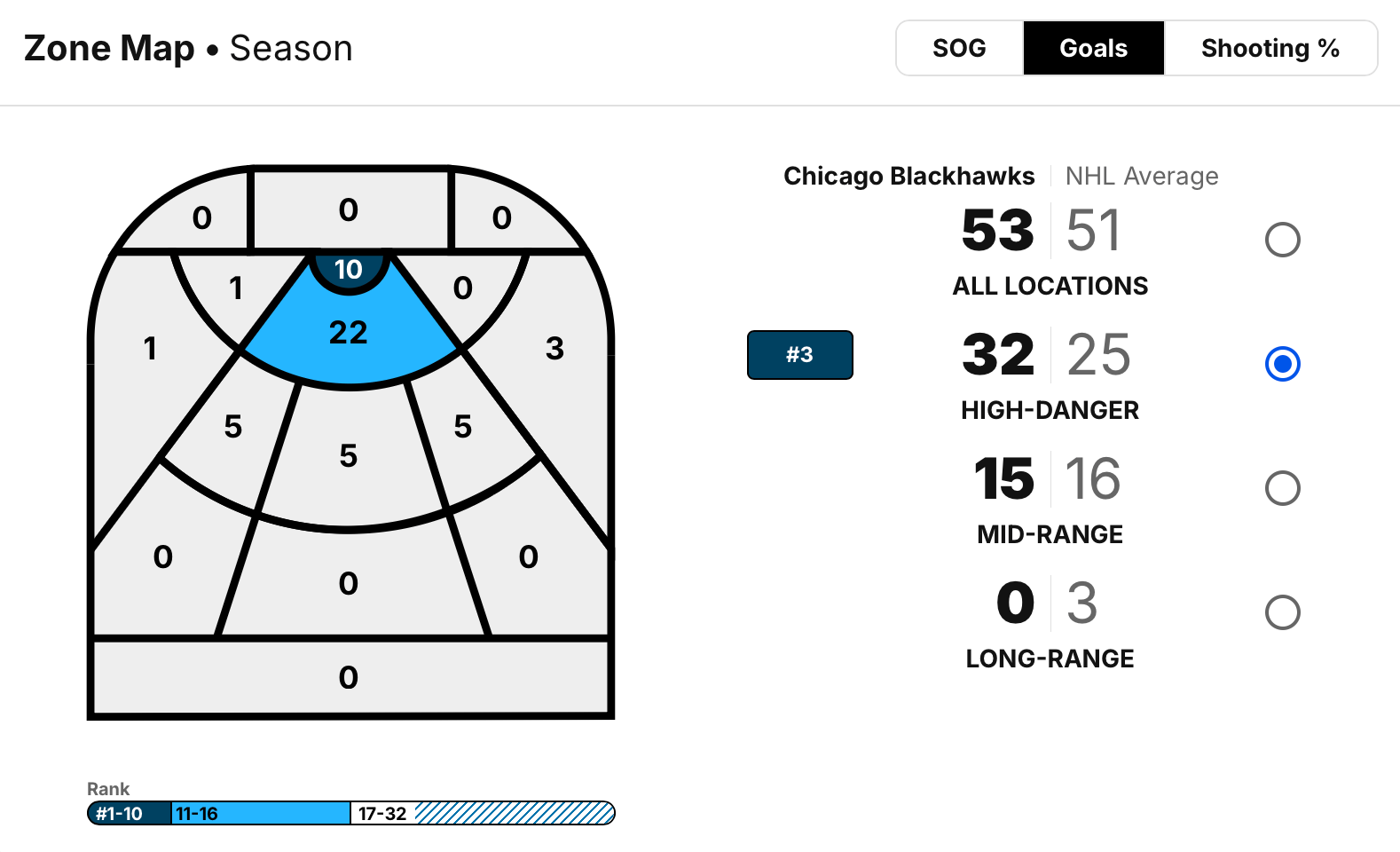
“How we want to play is below the hash marks, especially the ten-foot area around the net,” Foligno said. “We have a lot of skill, more than people realize. You look at Bert [Bertuzzi] around the net, it’s almost automatic right now…I do think there is more of an emphasis on us getting engaged on the inside.”
The Blackhawks are above the NHL average in goals scored from all locations, but third in the league when it comes to scoring around the net and the league’s best team at scoring when they get chances in that area. A lot of that success can be attributed to Tyler Bertuzzi’s ability to score at the net-front.
“We are a team that wants more chances, too. I’ve always thought you get chances from shooting the puck and getting second and third chances off of that,” Donato said. “Our chances look a bit different than last year, but I still think we want to create more. … It’s a tough league. To score on these goalies, you have to get more chances, but at the same time, there’s a lot of ugly goals in this league.”
Shot Selection
Successful teams and playoff-bound teams aim to have seven or more high-danger shots on goal per game, whilst also aiming to have fewer than 12 low-danger shots on goal per game, according to former NHL goalie Steve Valiquette. Valiquette is also the CEO of Clear Sight Analytics, an analytics company that is contracted to teams in the NHL.
The Blackhawks are close to hitting both of those benchmarks through the first 16 games of the season this year. Also, according to Valiquette and his company’s internal numbers, teams need to clear eight key data points to be considered ‘playoff-caliber,’ including but not limited to defending rush chances, preventing high-danger chances on the penalty-kill, and the two previous points mentioned about high and low-danger shots per game.
In Valiquette’s words during a recent appearance on “Real Kyper and Bourne,” the Blackhawks are “in” as a playoff-caliber team by reaching those key data points.
High-danger shots on goal per game (5-on-5): Blackhawks rank 22nd (6.64/per 60)
Low-danger shots on goal per game (5-on-5): 11th (11.4/per 60)
High-danger shots for (5-on-5): 14th (38)
Medium-Danger shots for (5-on-5): 19th (109)
Low-Danger shots for (5-on-5): 26th (359)
So while their overall shots on goal numbers put them in the basement of the league, the Blackhawks are not wasting their limited possession time with shots on goal from distance that have extremely low percentages. They know they are not going to get a ton of time with the puck most nights, so they work to make the most of it when they do.
Want evidence? Look at Sunday afternoon’s 5-1 win over the Detroit Red Wings, where they were outshot 46-20.
To harken back to Jeff Blashill’s words, “You didn’t get out-played, you got out-shot. There’s a difference.”
Power play
Coming into Wednesday night’s game against the New Jersey Devils, the Blackhawks are a perfect four-for-four over their last two games while on the power play. They had three power plays against the Detroit Red Wings on Sunday and scored on all three of them, with a total of three shots on goal.
While that is not the norm or the expectation moving forward, the power-play has been very successful (once they get set up) at following the same trends that the team has seen at even-strength this season: low chance quantity, high chance quality.
Corsi-For (PP): Blackhawks rank 32nd (84.93/per 60)
Shots-For (PP): 31st (42.91/per 60)
Goals-For (PP): 4th (10.73/per 60)
Shooting% (PP): 1st (25.0)
Power plays: 22nd (47)
“If you’re on the penalty-kill and a team is shooting from far away, it gives you confidence that you’re not giving up much and your goalie should make those saves,” Foligno said. “If you get one prime chance on the inside, now they’re more scrambley, now they’re more uncomfortable.”
The power play is another area where Tyler Bertuzzi has become a threat for the Blackhawks, setting himself up essentially as a backboard for shots on net and rebound attempts on the weak-side post.
It’s these types of niche areas of the game that the Blackhawks are finding success in. They aren’t set up to play like the Dallas Stars, Colorado Avalanche, or Carolina Hurricanes, where they can out-shoot, out-chance, and out-talent their way to success.
Chicago is playing this season like Floyd Mayweather Jr. or Pernell Whitaker boxed; not trying to land bombs and not trying to out-punch you, but when the opening is there, they strike.
Is this all sustainable? The belief is in the room that it is.
This is the offensive identity the team is building, and when you find success playing this kind of playoff-style hockey, buying in is easy.
(All data provided by Natural Stat Trick, Money Puck, and NHL EDGE)