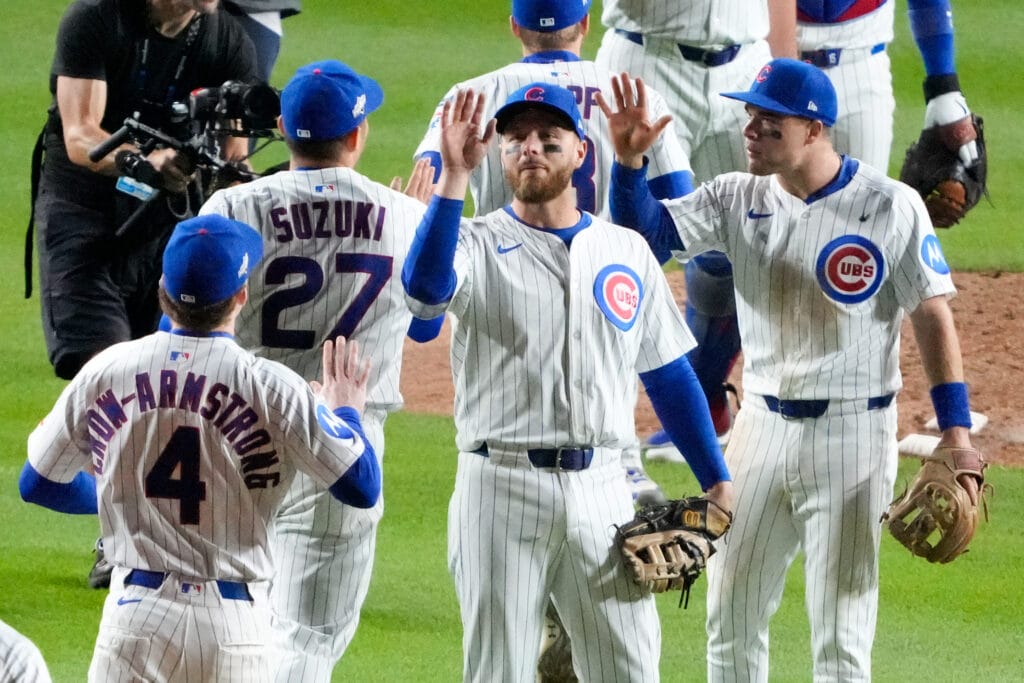

The Cubs‘ 2025 season will last at least one more day. It’s been since Game 5 of the 2017 division series against the Nationals that they have scored more than three runs in a playoff game, and the four they posted in NLDS Game 3 on Wednesday proved to be just enough.
Those are the important things: The Cubs beat Milwaukee, 4-3, and will have a shot an evening up the series on Thursday night at home. If they are going to be successful in Game 4 on Thursday — and perhaps beyond that — then there are still a few areas of concern showcased in Wednesday’s win that will need to be addressed.
Cubs manager Craig Counsell joked after Game 3 that he was going to tell his batters that every inning was the first inning, a nod to the fact that his guys have done really well at scoring runs in the first inning in this series, but not so much after that.
On Wednesday, Michael Busch hit a leadoff homer to erase the run the Brewers scored thanks in part to a surprising no-call on a potential infield fly rule in the top of the first inning. (Fun fact, according to the Elias Sports Bureau, Busch is the first player in MLB history to hit multiple leadoff home runs in one postseason series.) Then the Cubs plated three more runs on a sequence of base hits, walks, a run scored on a wild pitch, and a two-out, two-RBI single by Pete Crow-Armstrong.
“That’s the goal every time is just to take advantage of moments where guys do it in front of you,” Crow-Armstrong said. “I’m pretty fortunate in a couple of these elimination games to just have pretty nice opportunities in front of me with guys on base, and I think that makes this job just a little bit easier sometimes.”
From the second inning on, however, the Cubs got just six more baserunners and only twice had someone in scoring position. Counsell has had to repeat ad nauseum during the regular season and playoffs about the need to create more scoring opportunities, but that has yet to really happen for the Cubs in the postseason.
Typically, chasing the other team’s starter from the game early, like the Cubs did with Brewers starter Quinn Priester in Game 3, would be a good thing. That means they are into the opponent’s bullpen early in the game and can typically tack on a few more runs. But just like with Padres starter Yu Darvish in Game 3 of the wild card series, getting Priester out of the game had the opposite effect on the Cubs lineup. It might be fair to wonder if having to face a new reliever every at-bat actually makes things a little tougher.
“We’re at a time in baseball when starters don’t face the third time through that much, and now oftentimes not facing guys twice,” Nico Hoerner said. “We’ve played the Brewers a lot, and [they] obviously have a strong bullpen, but we’ve faced a lot of their guys throughout the year, so maybe that helps a little bit with familiarity.”
It could be the case that the Cubs’ struggling to score after the first inning has something to do with facing a new bullpen arm each time up, and the fact that the Brewers didn’t fare much better against the Cubs bullpen after putting up two runs against Jameson Taillon might support that. Regardless, it is objectively a good thing that Milwaukee manager Pat Murphy had to use more arms than he likely planned to in order to get through Game 3. Jose Quintana pitched three innings and Grant Anderson tossed two, so presumably neither of them would be available Thursday night. That could potentially work to the Cubs’ benefit in Game 4.
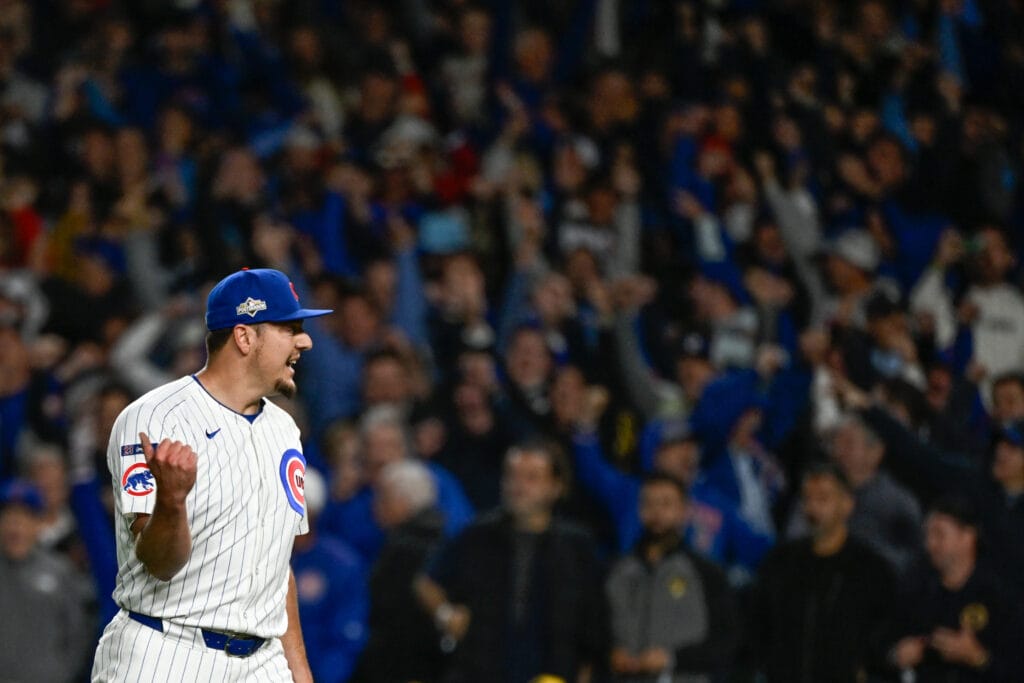
But give credit where it’s due: Taillon once again gave the Cubs a chance to in an elimination game, and the bullpen shut down Milwaukee’s offense with the lone exception of Jake Bauers’ leadoff solo homer in the seventh inning. Most importantly, Caleb Thielbar and Brad Keller combined to shut down a potential game-shifting situation with bases loaded in the eighth inning.
Keller had to come in for a four-out save that started with a two-out, bases loaded strikeout against Bauers, who had brought the game within a run in the previous inning.
“I just try to take the same mentality, just go after guys,” Keller said. “Obviously, that was a bigger moment coming in there. And so [I was] really trying to slow it down as much as I could and get strike one.”
For all of the reasons the Cubs’ backs are against the wall in this series, it should be mentioned that the bullpen has been nails all postseason. That group has demonstrated that when called upon, they will get outs. The questions for Game 4 on Thursday will be who starts the game (and how well that pitcher performs), and whether the offense can at last solve the riddle of scoring insurance runs after the first inning.
As for the first of those questions, the order of the division series would flip back to Matt Boyd. He pitched Game 1 in Milwaukee on Saturday with disastrous results, but he would be on regular rest on Thursday night — which wasn’t the case in Game 1 — and he only threw 30 pitches in that start, so it’s safe to say he would be fully rested. Counsell said there were still conversations to be had about his Thursday starter, but Boyd was at his locker after Game 3 and said he was looking forward to getting the ball again and said he would be ready to pitch.
As Cubs fans saw in the wild card series, Counsell is not afraid to use an opener, so it’s possible he could take that path with Boyd in Game 4 and wait until after the top three bats in the Brewers lineup have batted once before getting him in the game. That didn’t work quite according to plan in Game 2 of the wild card against San Diego, but that’s not necessarily reason not to employ a similar strategy on Thursday night.
The offense’s woes are a similarly difficult puzzle to solve. Judging by the first inning on Wednesday, they’re firing on almost all cylinders, so shuffling the order or putting new guys in the lineup might not be the answer. The better question might be why Counsell isn’t going with guys like Moises Ballesteros in pinch-hit situations later in the game to try and give the offense a spark.
The challenge with that is guys like Dansby Swanson, Ian Happ, and Matt Shaw who aren’t producing at the plate are big losses defensively when they come out of a game, so in a close one like Wednesday, the defensive sacrifice is probably not worth the potential offensive gain in a pinch-hit situation.
All of that will be put to the test in Game 4, when once again the Cubs are in a must-win situation. But where that could put too much pressure on a team, the guys in the home locker room at Wrigley Field say it’s more of a galvanizing force.
“It’s fun and stressful in the same sentence, in the same light, and I think you feel both emotions a lot,” Counsell said. “But you’re playing to play tomorrow, and that can’t help but give you something else. It has to.”