

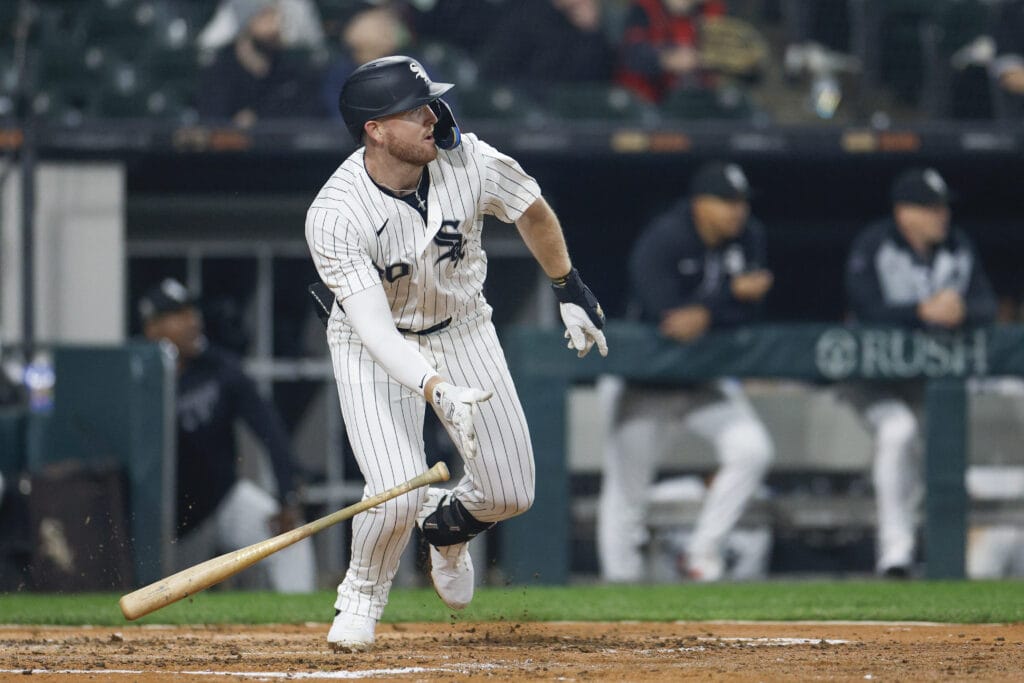
There’s a lot less fanfare the second time a player is called up to the big leagues. When first baseman Tim Elko first arrived in Chicago almost a month ago, his debut was much-anticipated because he had been clubbing homers for Triple-A Charlotte and the White Sox needed some offense at first base. Elko provided some of that for the Sox; three of his five hits were homers, but he only had five hits in 31 at bats and was sent back to Charlotte on May 23.
The move was a bit of a head-scratcher, given that Andrew Vaughn was demoted to Triple-A at the same time, leaving the White Sox without a true first baseman on the major league roster. There were also questions as to whether 31 at-bats was enough runway for Elko to show what he could do, but as it was explained to him at the time, he was going back to Charlotte because of needs on the 26-man roster, not necessarily because of his performance.
“I got a call from Will [Venable], and he said they needed to make a move with two guys coming off of the IL,” Elko told CHGO. “He gave me some motivation to keep doing what I was doing and keep working every day.”
Those guys were Andrew Benintendi and Mike Tauchman, and the team wasn’t going to cut into the pitching staff to make room for them, so a batter like Elko with options made the most sense, regardless of how he was doing at the plate.
Sometimes that’s how it goes. A team’s roster needs to shift throughout the season, and there aren’t always obvious choices for who to send down to the minors when space on the major league roster has to be cleared. In either case, whether a guy is going down because he needs to work on improving or because the team just needs his spot, White Sox manager Will Venable said he tries to give his players a sense of purpose when they’re headed down to Charlotte.
“You want to send them down, when you do send them down, with something, with a game plan,” Venable said. “We always want to have a game plan for these guys and make sure we’re seeing things the same way, and we’re aligned on how we’re going to get better every day.
In some cases, Venable said, he has to talk to players about areas of improvement, so that game plan has specific foci for the player to work on in order to earn a return to the major leagues. But in other cases, when a player — like Elko — is more a victim of the team’s normal roster machinations, the message is a little simpler.
“With Tim, that’s what it was,” Venable said. “It was, ‘Hey, just go down and keep doing what you’ve been doing and continue to learn.’ And part of his growth is now being here and making his adjustments at the big league level.”
Elko said his focus when he went back to Charlotte was to keep putting together good at-bats and to find more opportunities to do damage in the zone. There are still plenty of major league caliber arms in Triple-A, so it wasn’t tough to feel like he was staying consistent in his approach, Elko said.
With 11 home runs, eight doubles, and a .984 OPS for Charlotte this season, Elko has shown he can handle Triple-A pitching, as similar as it might be at times to baseball’s highest level. The difference when making the jump to the top, as Elko has seen, is that big league pitchers make a lot fewer mistakes.
“Everybody here is one of the best players in the world, and they’ve all got good stuff,” Elko told CHGO. “They’re good at locating their pitches, so it’s making sure you’re really focused each at-bat and making sure I’m swinging at pitches that I can handle and that are in the zone because these guys are good at throwing pitches that they want you to chase at and the ones that they’re trying to get over for strikes and get past you.”
Though Elko was not told he needed to make specific adjustments when he went back down to the minors, it’s hard to ignore the way he struggled at the plate during his first look at major league pitching. In those 31 at bats, Elko struck out ten times and walked just once. Again, he may have hit three home runs, but with just two singles otherwise, Elko had a .188 on-base percentage when he was sent to Charlotte nearly two weeks ago.
His sample size since returning is, of course, very small, so it will take a while to assess whether he has a chance at sticking around. Elko was recalled on Wednesday and went 1-for-4 in that night’s 5-4 loss to the Tigers. Batting sixth in the order in the 3-2 extra-inning win over Detroit on Thursday, Elko looked lost at the plate until his final at bat. He grounded out with the bases loaded in the first inning, struck out swinging in the third and went down looking with a runner on base in the fifth. With the game tied 2-2, Elko struck out swinging to lead off the eighth inning.
“My first few at-bats definitely weren’t my best, but you know in baseball you’ve got to have a quick memory and learn from your mistakes, then move on to the next one,” Elko said.
He took advantage of the redemption opportunity in the tenth inning, however. With one out and two runners in scoring position, Elko missed badly on Beau Brieske’s first slider but jumped on the second one, driving it into left field to score the runner from third and walk off the Tigers.
“I don’t think I was seeing the ball the best today, but it’s just at-bat to at-bat, pitch to pitch,” Elko said. “So I was able to see at least what the slider looked like, and [Brieske] left one a little bit higher so I was able to put a bat on it.”
Not the most encouraging start to Elko’s return to the majors, all things considered, but just like his first stint in the majors, Elko may take some time to start getting consistent base hits. Thursday’s walk off single is a good sign, but Elko will need to cut down on at-bats like the first four of the day. With Vaughn still in Triple-A working on improving the results he’s been getting with his bat this season, Elko might be given more time to grow at the major league level in his second turn in the big leagues.